
Disclaimer
This article is for informational purposes only. Nothing in this article is intended to replace legal advice from a competent attorney or be considered legal guidance for anybody's specific legal situation. Nobody should rely on information in this article in making legal decisions without such consultation.
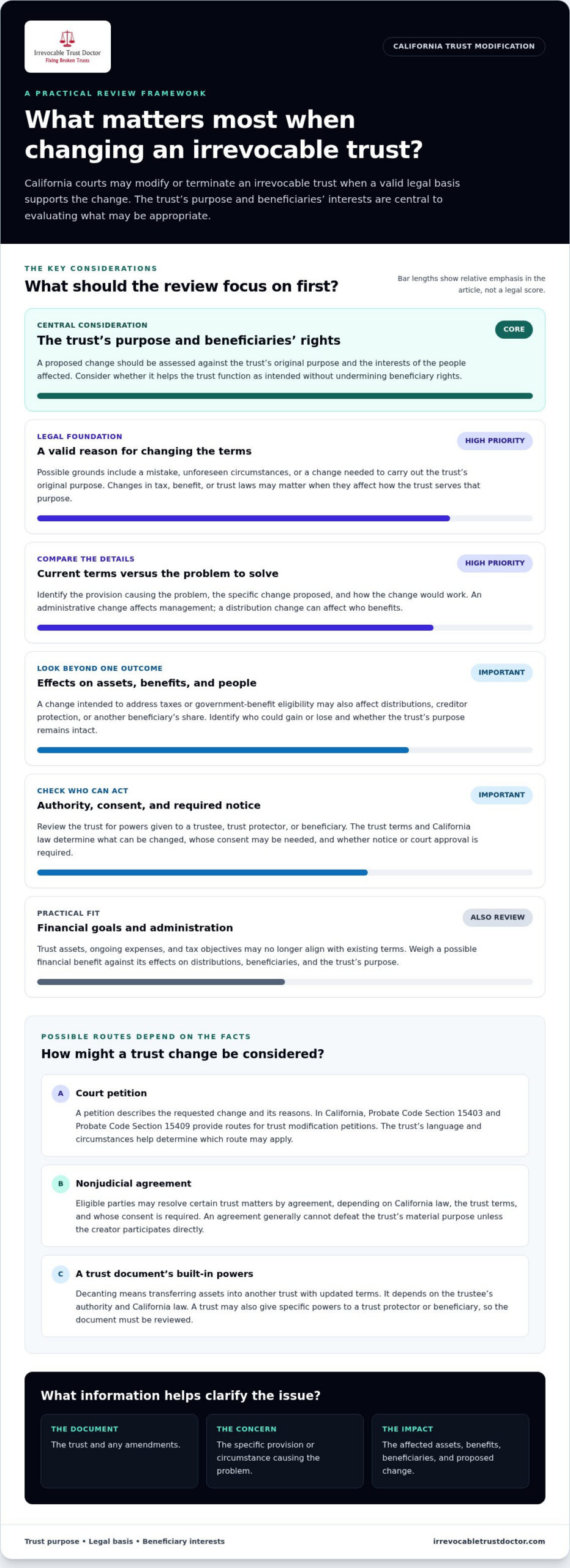
An irrevocable trust is not always unchangeable. In California, a court may modify one through a petition when there is a valid legal basis. Legal grounds for changing an irrevocable trust may include changed circumstances or changes in tax, benefit, or trust laws that affect its purpose. The trust’s terms and the proposed change both matter.
It’s understandable to assume that an irrevocable trust’s terms must remain fixed. This article explains when a change may be possible, how legal changes can affect the analysis, and what a court petition involves. The trust’s purpose and the beneficiaries’ interests are central to evaluating any proposed change.
Key Takeaways
- An irrevocable trust may still be changed in California when a valid legal basis supports the proposed modification.
- Review how changes in tax, benefit, or trust laws affect the trust’s purpose and the beneficiaries’ interests.
- Compare the trust’s current terms with the problem you want to solve before deciding whether to seek a modification.
- For an uncontested court petition, learn how the filing process may apply to your trust and its circumstances.
Can an Irrevocable Trust Be Changed?
Under California law, state statutes determine the legal grounds for changing or terminating an irrevocable trust. California courts may consider a mistake, unforeseen circumstances, or a change needed to carry out the trust’s original purpose.
When Can a Court Approve a Modification?
A court-approved modification is an order changing trust terms or, in some cases, ending the trust. It may be relevant when circumstances the creator did not anticipate make the original terms impractical or frustrate the trust’s purpose. A petition sets out the requested change and its reasons; the court considers beneficiary rights and the trust’s purpose. Notice rules depend on California governing law and the specific case. The equitable deviation doctrine describes adapting trust terms to changing circumstances so the trust can function as intended. Begin by identifying the problem, the proposed change, and the people whose interests may be affected. Filing and legal costs depend on the procedure and case.
How Do Nonjudicial Modification Agreements Work?
A nonjudicial settlement or modification agreement allows eligible parties to resolve certain trust matters without asking a judge to decide them. Its scope depends on California law, the trust terms, and whose consent is required. Generally, an agreement cannot defeat the trust’s material purpose, meaning a central goal set by its creator, unless the creator participates directly. California law provides a framework where interested parties may utilize nonjudicial measures if the change remains consistent with the trust’s material purpose. A transfer to another trust may be one possible route, depending on the governing law and circumstances. These rules are specific to California statutes, not a nationwide consent formula.
What Financial Reasons May Prompt Modification?
Financial changes may prompt a review when trust assets, expenses, or tax objectives no longer align with the terms. For example, a trust created to reduce estate taxes may later create tax problems or stop serving that purpose. Modification may also be considered when ongoing administration costs no longer make sense for the assets held. When evaluating these options with guidance from professionals like The Irrevocable Trust Doctor, weigh the proposed financial benefit against possible effects on distributions, beneficiaries, and the trust’s purpose. A tax advantage alone does not establish that a particular change is appropriate.
How Can Decanting and Built-In Change Powers Affect a Trust?
Decanting means a trustee transfers assets into another trust with updated terms, subject to California law limits and the trustee’s authority. State rules differ across jurisdictions, but California statutes permit decanting under specific conditions when a trustee has discretionary power to distribute principal. A trustee cannot assume this power exists without reviewing the trust and applicable law. The document may also authorize a trust protector to change specified provisions or require that person’s approval. A power of appointment may let a beneficiary direct where assets pass among designated people. Review each clause to determine who may act, which terms may change, and whether consent or notice is required.
How Can Changes in Tax, Medicaid, Disability-Benefit, and Trust Laws Affect a Trust?
Changes in tax rules, Medicaid requirements, disability-benefit regulations, or trust statutes can affect whether existing provisions still serve their intended purpose. For example, a trust designed around earlier estate-tax rules may later create tax problems. A change may be considered if updated terms can address the issue while preserving the trust’s main purpose and beneficiaries’ rights.
Look beyond tax outcomes. Changing how assets are held or distributed can weaken creditor protection or shift benefits between beneficiaries. A change intended to help one beneficiary qualify for government benefits may also affect another beneficiary’s share. Before proposing new terms, compare the trust’s current language with the specific tax or benefit concern, and identify who could gain or lose.
Can the grantor and all beneficiaries consent to a change? Some states allow consent-based modifications, but requirements vary, and some require the grantor’s participation. An agreement generally cannot defeat the trust’s material purpose unless the grantor participates directly. Beneficiary agreement also does not automatically resolve every issue; court approval may be needed to protect people’s rights or approve the proposed change.
For a practical review, gather the trust document, amendments, and a clear description of the affected assets and benefits. Then identify whether the proposed change is administrative, meaning it changes management rather than who benefits, or affects distributions. An attorney can assess the provisions, applicable law, and required participation before a petition or agreement is prepared. A Trust Petition Consultation can help assess whether a court petition fits the proposed modification.
How Can Changes in Trust, Estate, Probate, or Tax Laws Affect a Trust?
A legal change does not automatically rewrite an irrevocable trust. It may reveal a mismatch between the original terms and current tax rules, benefit programs, or trust law. For example, an estate-planning structure built around earlier tax rules may no longer produce its intended result. That mismatch may support legal grounds for changing an irrevocable trust if a lawful adjustment can address it without undermining the trust’s purpose or beneficiaries’ rights.
In California, Probate Code Section 15403 and Probate Code Section 15409 provide routes for trust modification petitions. The trust’s language, requested change, and circumstances help determine which route may apply. A change to administrative details raises different concerns from one that alters distributions. Decanting, which transfers assets into another trust with revised terms, also depends on legal authority and applicable limits.
Consider a trust created to protect a beneficiary’s inheritance while supporting family goals. A later tax-law change or new trust-law provision could affect how its terms work. That may prompt a review, but flexibility cannot undermine the trust’s central purpose or unfairly shift benefits. California families evaluating legal grounds for changing an irrevocable trust should compare the current terms with the proposed outcome, including effects on taxes, asset protection, and each beneficiary.
Before pursuing a judicial modification or agreement, identify the legal change, the affected provision, and the correction sought. Then assess whether the proposal protects the trust’s purpose and beneficiaries’ interests. Tax and benefit consequences can follow even when revised distribution language seems preferable. Discuss a trust modification petition to evaluate how a proposed change relates to California law.
The Irrevocable Trust Doctor: Irrevocable Trust Modification Petition
The Irrevocable Trust Doctor, a service of attorney Robert P. Bergman, Board-Certified Specialist in Estate Planning, Trust, and Probate Law (California State Bar Board of Legal Specialization), assists families, attorneys, and their clients throughout the State of California with uncontested trust modification petitions.
Under Probate Code Section 15403 and Probate Code Section 15409, petitions may be filed ex parte in Santa Clara County Probate Court, regardless of where in California the trust is located. An ex parte request is a way to ask a court to consider a matter outside the usual hearing process. Santa Clara County petitions are typically granted in 7 to 10 days. The office handles uncontested petitions only, not contested matters.
If you’re weighing a proposed change, a Trust Petition Consultation can help assess whether an uncontested petition fits your situation. Contact The Irrevocable Trust Doctor to discuss the trust and the change you’re considering.
Prepare for a Clear, Informed Next Step
Before pursuing a change, note the trust provision causing concern and the outcome you want instead. Gather the trust document, amendments, and records explaining why the original terms no longer work. This helps connect the proposed change to the trust’s purpose and identify who may be affected.
A focused review of the legal grounds for changing an irrevocable trust can distinguish a genuine legal basis from a preference for different terms. Consider how the change could affect distributions, asset protection, and each beneficiary, then clearly frame the issue for a petition consultation.
Schedule a Trust Petition Consultation to discuss your proposed change and possible next steps. A careful start can bring greater clarity to a difficult trust issue.
Frequently Asked Questions
How can a court modify an irrevocable trust because of changed circumstances or unforeseen events?
A court may consider a modification when an unforeseen event makes the existing terms impractical or interferes with the trust’s purpose. Explain what changed, when it happened, and how the current wording creates a problem. For example, a beneficiary’s changed circumstances might make a planned distribution unsuitable. The proposed remedy should address that specific difficulty while protecting affected beneficiaries.
When can a court modify or terminate an irrevocable trust to achieve the settlor’s original purpose?
A court may consider changing or ending a trust when doing so would better carry out the settlor’s original purpose, particularly if that purpose has become impossible or impractical. Connect the requested result to evidence of the settlor’s intent, such as the trust’s distribution structure and stated goals. A preferred outcome alone does not establish that connection.
How do state statutes such as the Uniform Trust Code govern modification of irrevocable trusts?
The Uniform Trust Code is a model law, and states may adopt different versions or rely on their own trust statutes. A rule described for another state may not govern a California trust. Identify the trust’s governing law and the court where a petition would be considered, then compare the applicable statute with the trust’s terms before relying on an out-of-state rule.
Can an irrevocable trust be changed to correct a mistake, resolve ambiguity, or reform tax provisions?
Yes, a court may consider correcting a drafting mistake, clarifying unclear language, or addressing tax provisions that frustrate the settlor’s intent. Identify the exact wording at issue and show how the correction reflects the trust’s original purpose. For example, compare the disputed clause with other trust provisions and documents explaining the intended distribution or tax objective.
What tax, beneficiary, creditor, and trustee risks can result from changing an irrevocable trust?
A change can create income, gift, or generation-skipping tax consequences, weaken creditor protection, or shift distributions between beneficiaries. It can also put a trustee in a difficult position if the proposed terms conflict with duties owed to beneficiaries. Before proceeding, map who receives or loses assets, assess tax effects, and consider whether the trustee can administer the revised terms fairly.

Article by
Robert P. Bergman, Attorney at Law
Attorney Robert P. Bergman ("Bob Bergman") has been a Board-Certified Specialist in Estate Planning, Trust and Probate Law since 2011, as certified by the California State Bar Board of Legal Specialization. For several years, Bob has assisted families and the clients of other attorneys with obtaining court orders through trust modification petitions to make necessary modifications to existing irrevocable trusts. Bob is friendly, very approachable, and believes in explaining complex legal topics in clear ordinary language so that his clients understand exactly what they're doing and why they're doing it.
Bob is often able to assist clients throughout California who are in other counties than his home county of Santa Clara through his approach to trust modification petitions.