
Disclaimer
This article is for informational purposes only. Nothing in this article is intended to replace legal advice from a competent attorney or be considered legal guidance for anybody's specific legal situation. Nobody should rely on information in this article in making legal decisions without such consultation.
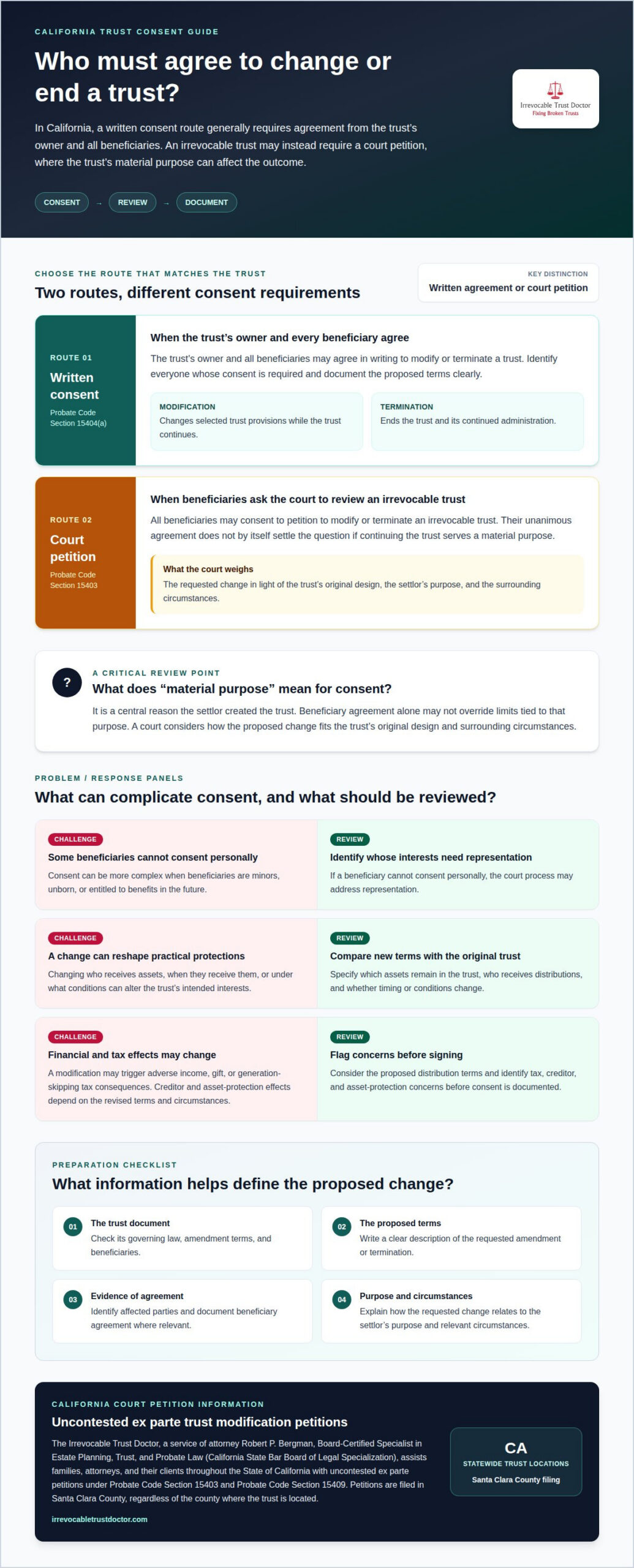
In California, a consent-based trust change generally requires agreement from all beneficiaries. Under Probate Code Section 15404(a), all beneficiaries and the trust’s owner may agree in writing to modify or terminate a trust; a court petition follows a separate route, and the grantor’s support matters if the grantor is living.
A trust modification changes one or more trust terms, while termination ends the trust. Determining whose consent counts can be more complex when beneficiaries are minors, unborn, or entitled to receive benefits in the future.
This guide explains when beneficiaries and grantors can consent to a change or termination, how court approval differs from a written agreement, and what happens after approval. It also describes how California law addresses consent on behalf of certain beneficiaries, helping you assess which process may apply to the trust.
Key Takeaways
- Understand why unanimous agreement may not settle the question when a proposed change conflicts with the trust’s material purpose.
- Learn how revocable and irrevocable trusts differ, and why the trust document and governing law matter.
- See how a court petition can address an irrevocable trust change and what factors shape the court’s review.
- Find out when an uncontested ex parte petition may be an option for a California trust, including one located outside Santa Clara County.
What Happens After a Court Approves a Modification or Termination?
After a court approves a modification or termination, the trustee must follow the order. If the court authorizes termination, the order governs the next steps for the trust property.
How Do Material Purposes Affect Court-Approved Changes?
A trust’s material purpose is a central reason the settlor created it, and California courts consider that purpose when reviewing a proposed change. Beneficiaries may petition the court if they agree unanimously, but their agreement alone does not override limits tied to a material purpose. The court considers the requested change in light of the trust’s original design and surrounding circumstances.
What Steps and Documents Are Needed for Consent-Based Changes?
To seek a consent-based change, gather the trust document, a written description of the proposed amendment, and evidence of beneficiary agreement. A petition describes the requested relief, relevant circumstances, and how the change relates to the settlor’s purpose. This gives the court a basis to assess the consent and proposed terms. If a beneficiary cannot consent personally, the court process may address representation.
According to the California Legislature, California Probate Code Section 15408 addresses trust termination or modification when a trust’s value is low relative to its administrative costs. After approval, the trustee must act within the authority granted by the order. For a termination, the order also guides what happens to the trust’s remaining property.
Can All Beneficiaries Agree to Change a Trust?
Sometimes, but beneficiary agreement alone may not be sufficient. The trust’s terms, the grantor’s consent, and California law can affect the available process. Trust modification by consent of beneficiaries requires identifying all parties whose consent is needed and following the rules that apply to the trust.
How Does Modification Differ From Termination?
Modification changes selected provisions; termination ends the trust and brings its continued administration to a close. The distinction matters because beneficiaries may want to update distribution terms without ending the arrangement. Under California Probate Code Section 15404(a), all beneficiaries and the trust’s owner may agree in writing to modify or terminate a trust. For other consent routes, the required parties and court approval depend on applicable law.
How Do Consent Rules Differ by State?
Consent rules vary by state, so the trust’s governing law is a key starting point. Under Uniform Trust Code section 411(a), a court may approve modification or termination when the settlor and all beneficiaries consent, even if the change conflicts with a material purpose. In California, Probate Code Section 15404(a) permits the trust’s owner and all beneficiaries to agree in writing. A trust modification by consent of beneficiaries may therefore follow different steps depending on the governing law; beneficiary agreement alone does not always eliminate court review.
What Risks Can Consent-Based Modification Create?
A consent-based change can affect the trust’s intended interests and the settlor’s original intent. Review the proposed distribution terms carefully: changing who receives assets, when, or under what conditions may alter the trust’s practical protections. Modifications may also trigger adverse income, gift, or generation-skipping tax consequences. Creditor and asset-protection effects depend on the revised provisions and circumstances, so identify those concerns before signing an agreement. A trust petition consultation can help assess the consent and petition issues.
How Can Beneficiaries and a Grantor Consent to Modify or Terminate a Trust?
Start with the trust document: identify its governing law, amendment terms, beneficiaries, and requested change. In California, Probate Code Section 15404(a) allows the trust’s owner and all beneficiaries to agree in writing to modify or terminate a trust. This written agreement can document a trust modification by consent of beneficiaries.
For an irrevocable trust, identify whether the grantor is living and whether the proposed terms preserve the estate-planning purpose. Under Probate Code Section 15403, all beneficiaries may consent to petition the court to modify or terminate an irrevocable trust, subject to limits when continuation serves a material purpose. A trust modification by consent of beneficiaries may therefore require court review, depending on the route and circumstances.
Before signing, compare the proposed document with the original trust. Specify which assets remain in the trust, who receives distributions, and whether timing or conditions change. Include all affected parties in the written agreement, and address disputes about valuation, eligibility, or future distributions. For example, changing a child’s staged distribution to an immediate payout changes access to assets and the structure of the estate plan. A court may consider the parties’ interests and the settlor’s intent, not only their signatures.
If the parties disagree or court review is needed, a Trust Petition Consultation can help assess whether an uncontested petition fits. Discuss consent and petition options.
How Can The Irrevocable Trust Doctor Help With an Irrevocable Trust Modification Petition?
The Irrevocable Trust Doctor, a service of attorney Robert P. Bergman, Board-Certified Specialist in Estate Planning, Trust, and Probate Law (California State Bar Board of Legal Specialization), assists with uncontested Irrevocable Trust Modification Petitions.
The office assists families, attorneys, and their clients throughout the State of California with uncontested ex parte petitions under Probate Code Section 15403 and Probate Code Section 15409. The office regularly files these petitions in Santa Clara County, regardless of the county where the trust is located. This includes trusts located in Los Angeles County or Alameda County.
An ex parte petition is handled without a formal hearing. In Santa Clara County, petitions are typically granted in 7 to 10 days. San Mateo County petitions can be filed, heard, and granted the same day. Contra Costa County petitions can often be filed and granted the same day if urgency satisfies the Court.
The Irrevocable Trust Modification Petition addresses the requested trust change. A Trust Petition Consultation helps assess whether an uncontested filing fits. Fixed fees cover filing fees and attorneys’ fees.
The office handles only uncontested ex parte petitions, not contested matters. If disputes remain, this filing route is not suitable. To discuss an uncontested petition, contact The Irrevocable Trust Doctor.
What Should You Consider Before Choosing the Next Step?
Before taking action, write down the change you want and the practical result you hope to achieve. Consider how the proposed result would affect the trust’s long-term role in the family, not just the immediate request.
For trust modification by consent of beneficiaries, start by identifying the questions that need clear answers. Note which terms would change, what outcome the parties expect, and any concerns that could affect their decision. This gives discussions a focused starting point and helps reveal whether everyone understands the proposed change in the same way.
Once those issues are clear, you can approach the next conversation with a more defined goal. Thoughtful preparation can make a complex decision easier to work through, one question at a time.
Frequently Asked Questions
What Is a Trust Modification?
A trust modification changes how particular terms operate without necessarily ending the trust. For example, an amendment might clarify a distribution condition while leaving other provisions in place. The practical question is how the revised language would affect trustees and beneficiaries. Compare the proposed wording with the current document to identify any changes to rights and responsibilities.
Can a Single Beneficiary Force Changes?
No. One beneficiary’s preference does not establish unanimous consent. A beneficiary may raise a concern, but the available court process depends on the reason for the requested change and the trust’s circumstances. For example, unclear language or an unforeseen event may call for a different legal analysis than a request to receive assets earlier.
Do Beneficiaries Have Other Options When Circumstances Change?
Yes. Depending on the trust document and California law, a trustee may have a statutory option to decant, meaning transfer assets to another trust under permitted conditions. A trust protector may also have authority to change specified terms if the document grants that power. These routes differ from beneficiary agreement, so identify who holds the relevant authority.
How Do Spendthrift Provisions Affect Modification Rights?
A spendthrift provision restricts a beneficiary’s ability to transfer their interest and can protect that interest from certain claims. California law gives valid transfer restraints significant protection. Under Probate Code Section 15403, a court must find good cause to terminate a trust with a valid restraint on transfer. A beneficiary’s agreement therefore may not, by itself, remove that protection.
What If the Settlor Is Still Alive?
In California, the settlor’s status can affect the consent route. Under Probate Code Section 15404(a), the trust’s owner and all beneficiaries may agree in writing to modify or terminate the trust. For a court petition, a living grantor’s support may also matter when all beneficiaries consent. Review the trust’s terms and identify the correct parties before preparing an agreement.

Article by
Robert P. Bergman, Attorney at Law
Attorney Robert P. Bergman ("Bob Bergman") has been a Board-Certified Specialist in Estate Planning, Trust and Probate Law since 2011, as certified by the California State Bar Board of Legal Specialization. For several years, Bob has assisted families and the clients of other attorneys with obtaining court orders through trust modification petitions to make necessary modifications to existing irrevocable trusts. Bob is friendly, very approachable, and believes in explaining complex legal topics in clear ordinary language so that his clients understand exactly what they're doing and why they're doing it.
Bob is often able to assist clients throughout California who are in other counties than his home county of Santa Clara through his approach to trust modification petitions.