
Disclaimer
This article is for informational purposes only. Nothing in this article is intended to replace legal advice from a competent attorney or be considered legal guidance for anybody's specific legal situation. Nobody should rely on information in this article in making legal decisions without such consultation.
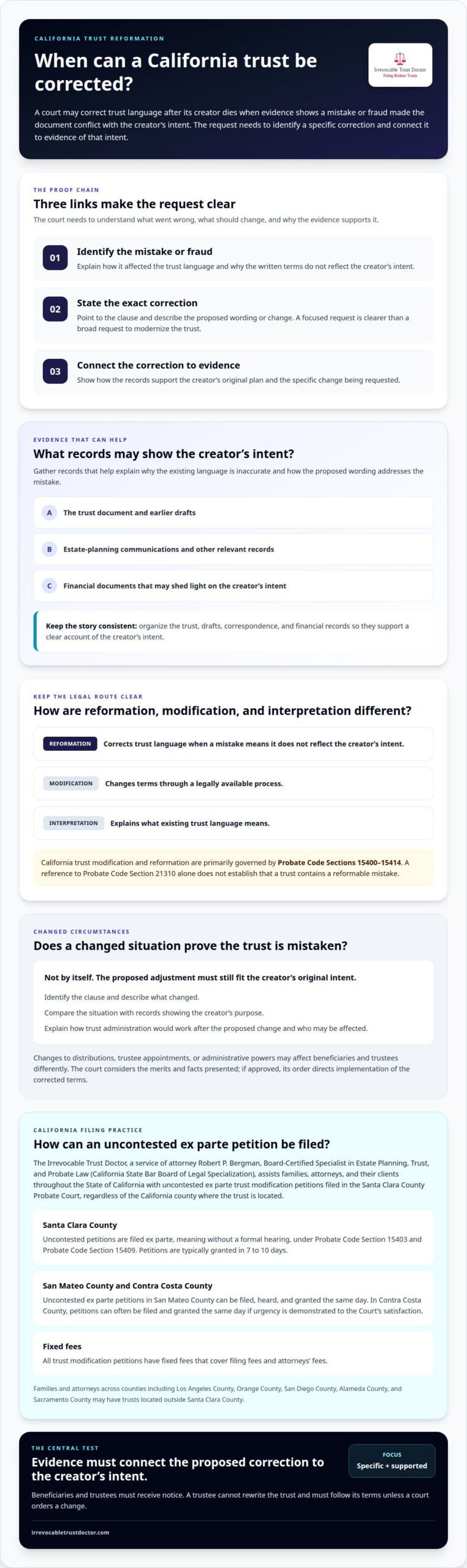
A trust can sometimes be changed after its creator dies, but beneficiaries cannot rewrite an irrevocable trust themselves. A petition to reform a trust for mistake in California asks a court to correct trust terms when evidence shows that a mistake or fraud caused the document to conflict with the creator’s intent.
If trust language seems to defeat what the creator intended, it is understandable to wonder whether the written terms are final. The key question is whether evidence supports a specific correction, not simply whether a different arrangement now seems preferable.
This article explains when a court may consider reformation, what a petition generally needs to establish, and how changed circumstances may affect the request. It also describes the court process and the evidence that may matter if the court approves the correction.
Key Takeaways
- A court may reform a trust after its creator dies when evidence shows a mistake or fraud caused the document to conflict with the creator’s intent.
- Make the requested correction specific and connect it to evidence, such as earlier drafts, communications, or other records that help show the creator’s intent.
- California trust modification and reformation are primarily governed by California Probate Code Sections 15400-15414, according to the California Legislature.
- Changed circumstances may affect a trust modification request, but the focus remains on whether the proposed change fits the creator’s original intent.
Filing a petition in the appropriate California court
A trust reformation petition asks a California court to correct terms that may not reflect the creator’s intent. It must identify the proposed change and support it with relevant evidence.
How do you choose the appropriate California court?
The appropriate court is the California court asked to review the trust and grant the requested relief. Choosing the right court matters because filing location and procedure can affect how the petition moves forward.
Before preparing a filing, identify the trust document, its administration, and the circumstances surrounding the alleged mistake. Records about trust assets and the estate may help clarify the facts and the court process involved.
What happens during the petition process and after the court issues an order?
The petition should explain the alleged mistake, specify the proposed correction, and connect that correction to evidence of the creator’s intent. The court considers the merits, including whether a mistake or fraud affected the trust language.
Interested parties, including beneficiaries and trustees, must receive notice. A trustee’s fiduciary role does not permit rewriting the trust; the trustee must follow its terms unless a court orders a change. The order may set out corrected language or other approved modifications.
What forms and supporting documents are required?
There is no single universal list of forms for every trust reformation petition. A filing generally includes a petition stating the correction sought, its legal basis, and supporting evidence.
Gather the trust document and relevant records, such as earlier drafts, estate-planning communications, and financial documents that may shed light on the creator’s intent. These materials can explain why the existing language is inaccurate and how the proposed wording addresses the alleged mistake.
How much does it cost to file a California trust reformation petition?
The cost depends on the case and is provided after a quote request. Factors include the complexity of the trust document, the evidence to organize, and the relief requested.
Filing expenses and legal work are separate parts of the overall cost. Reviewing the requested changes and available records helps clarify the work involved. A wording correction may require different preparation from a request affecting trust assets or distributions.
Adapting trusts to changed circumstances
Changed circumstances can create a mismatch between a trust’s directions and the current situation of its beneficiaries or assets. A trust’s terms may need review when drafting errors or changed circumstances appear to conflict with the creator’s original intent. The key question is whether the requested adjustment fits that intent, not merely whether circumstances have changed.
For example, a trust may direct distributions based on a family or financial situation that later changes. Identify the specific clause, describe what changed, and compare it with records showing the creator’s purpose. A changed situation alone does not prove that the trust contains a mistake. Evidence must connect the proposed correction to the original plan.
This distinction matters to beneficiaries and trustees. Changes to distribution terms, trustee appointments, or administrative powers can affect parties differently and lead to disputes. Before filing, link each requested change to the clause it addresses, explain how trust administration would work afterward, and identify who would be affected. A specific request gives the court a clearer basis for review than a broad request to modernize the trust.
Courts assess proposed changes based on their merits and the facts presented. If a change is approved, the court’s order directs implementation of the corrected terms. Beneficiaries and trustees should be informed of the decision and revised language. Keep the trust document, drafts, correspondence, and relevant financial records together to present a consistent account of the creator’s intent.
If you’re weighing a proposed change, a Trust Petition Consultation can help clarify how the circumstances and supporting records relate to a petition.
California legal framework for trust reformation
California law distinguishes correcting trust language from changing or interpreting its terms. California trust modification and reformation are primarily governed by California Probate Code Sections 15400-15414, according to the California Legislature.
How do reformation, modification, and interpretation differ?
Reformation corrects trust language when a mistake causes it to fail to reflect the creator’s intent. Modification changes terms through a legally available process, while interpretation explains the meaning of existing language. The distinction matters because the court needs to know whether interested parties seek corrected wording, a permitted change, or clarification. For example, a clause that misstates a distribution may require a different analysis from an unclear clause.
Can a trust be reformed for a mistake under Probate Code Section 21310?
A trust may be reformed for mistake when evidence shows that its terms don’t express the creator’s intent. A reference to Probate Code Section 21310 alone doesn’t establish that a trust contains a reformable mistake. The petition should identify the specific error and explain how the proposed correction reflects the creator’s wishes. Earlier drafts, communications, or other records can help the court evaluate that connection.
California courts generally enforce trust provisions as written, so evidence must support court intervention. The court considers whether a mistake or fraud affected the document and whether the proposed wording corrects it. Interested parties, including beneficiaries and trustees, must receive notice. Keep the requested change narrow and connect each revision to evidence of the creator’s intent.
If you’re assessing the legal basis and supporting records, book a Trust Petition Consultation to discuss the petition’s fit.
The Irrevocable Trust Doctor: Irrevocable Trust Modification Petition
The Irrevocable Trust Doctor, a service of attorney Robert P. Bergman, Board-Certified Specialist in Estate Planning, Trust, and Probate Law (California State Bar Board of Legal Specialization), assists families, attorneys, and their clients with uncontested trust modification petitions. This may be a next step when the requested correction is supported and all interested parties agree to proceed.
The Irrevocable Trust Modification Petition is filed ex parte in Santa Clara County Probate Court under Probate Code Section 15403 or Probate Code Section 15409. The service is available throughout the State of California, regardless of the county where the trust is located. An ex parte petition can be a way to ask a court to act without the usual notice process. The office handles uncontested ex parte petitions only.
If you want to discuss whether this process fits your trust, contact The Irrevocable Trust Doctor.
Prepare a Clear Path Forward
A petition to reform a trust for a mistake in California is easier to assess when the desired outcome is precise. Write down what the trust currently directs, what you believe the creator intended, and how the proposed wording would resolve the difference. This focused comparison can keep discussions centered on the correction rather than broader family disagreements.
Consider what a workable resolution would mean for each person affected. If beneficiaries or trustees share an understanding, clarify their agreement and the specific change they support. If their views differ, identify the point in dispute and the evidence related to it. A clear account gives the next discussion a practical starting point.
For a tailored discussion of the petition process, schedule a Trust Petition Consultation. A careful next step can bring greater clarity to a difficult trust question.
Frequently Asked Questions
Can a trust be changed after the person who created it dies?
Yes. A creator’s death does not automatically prevent a California court from considering a request to correct a trust. A petition to reform a trust for mistake in California may be appropriate when the document appears to contain an error. Assemble the complete signed trust and all later amendments so the request can be considered against the full set of terms.
How Does the California Petition Process Work?
The process begins by preparing and filing a request that identifies the trust provision at issue and the relief sought. For a petition to reform a trust for mistake in California, prepare a short chronology of when the trust and amendments were signed and when the suspected error came to light. This helps keep document versions and events clear.
What Evidence Can Be Used to Prove a Mistake?
Evidence may include records or testimony that explain how the disputed wording came to appear in the trust. For each item, note who created it, when it was made, and how it relates to the specific clause. Preserve original documents and complete email conversations rather than relying only on excerpts or summaries that may omit context.
What Evidence Does the Probate Court Review?
The court may consider the trust as a whole, not just one sentence. Surrounding provisions can affect how the disputed language reads, so include the full relevant document rather than a single-page excerpt. Organize supporting material by date and note what each item helps explain. Clear, consistent records make the issue easier to understand.
What Happens If Someone Opposes the Petition?
An objection can turn an agreed request into a contested matter. The disagreement may concern whether the wording is mistaken, what the creator intended, or how a correction would affect a beneficiary’s share. Separate the disputed issues and identify the relief still requested. If interested parties do not agree, the matter cannot proceed as a clean ex parte petition.

Article by
Robert P. Bergman, Attorney at Law
Attorney Robert P. Bergman ("Bob Bergman") has been a Board-Certified Specialist in Estate Planning, Trust and Probate Law since 2011, as certified by the California State Bar Board of Legal Specialization. For several years, Bob has assisted families and the clients of other attorneys with obtaining court orders through trust modification petitions to make necessary modifications to existing irrevocable trusts. Bob is friendly, very approachable, and believes in explaining complex legal topics in clear ordinary language so that his clients understand exactly what they're doing and why they're doing it.
Bob is often able to assist clients throughout California who are in other counties than his home county of Santa Clara through his approach to trust modification petitions.