
Disclaimer
This article is for informational purposes only. Nothing in this article is intended to replace legal advice from a competent attorney or be considered legal guidance for anybody's specific legal situation. Nobody should rely on information in this article in making legal decisions without such consultation.
The words in a trust may not settle what they mean. A lawyer for ambiguous trust language in San Francisco can assess whether a provision has more than one reasonable meaning, conflicts with another clause, or becomes unclear only when a trustee applies it. California courts first read the document as a whole and may consider outside evidence if its wording doesn’t resolve the ambiguity.
If you are a trustee or beneficiary, you may want a clear interpretation before acting. But choosing an interpretation on your own could appear to take sides and expose a trustee to potential personal liability. This article explains what ambiguous trust language means, how California courts approach unclear terms, and what a legal review can clarify. It also distinguishes a question about interpreting a document from a situation in which changing an irrevocable trust may require a court petition.
Key Takeaways
- Notice whether unclear wording has more than one meaning on the page or only becomes confusing when someone applies it.
- Before acting on a disputed clause, examine how the trust’s provisions fit together and what context may help explain the wording.
- A trustee’s independent interpretation can appear to favor one beneficiary, so learn what a legal review can clarify before distributing assets.
- A court petition may be one option for seeking an uncontested modification of an irrevocable trust, depending on the circumstances.
How can a probate attorney review unclear language?
A probate attorney can compare disputed wording with the complete trust or will and identify practical ways to address the uncertainty. In San Francisco, reviewing the document before distributing assets can help a trustee avoid making an unsupported choice.
How does a lawyer review will and trust documents?
Bring the complete signed document, including amendments, and mark the clause that is unclear. A probate lawyer can read it alongside related sections, check names and asset descriptions, and determine whether the wording has multiple meanings or conflicts with another instruction. For example, if two clauses describe a gift differently, the document should be considered as a whole before anyone acts.
Who has standing to challenge or interpret a trust?
In California, a trustee responsible for carrying out the trust terms and a beneficiary whose interests may be affected both have a direct stake in an interpretation issue. A trustee may ask the court for instructions about ambiguous terms. A beneficiary can explain how a disputed interpretation could affect their rights, then have an attorney assess whether a court request fits the situation.
In a trust or probate dispute, separate questions about wording from allegations about conduct. If the disagreement concerns what a clause means, a focused review may clarify the issue before litigation becomes necessary. If a trustee chooses an interpretation without guidance, beneficiaries may see the decision as taking sides, and the trustee could face potential personal liability.
Keep the trust and its amendments together with a written list of unanswered questions. Note which assets or distributions each possible interpretation could affect. A lawyer for ambiguous trust language in San Francisco can use those details to explain the available options, including whether a petition for court instructions may be appropriate. This connects the document’s wording to the decisions facing a Bay Area family.
How do courts interpret ambiguous estate documents?
California courts begin with the document’s wording and context. If its provisions do not resolve the uncertainty, outside evidence may help clarify the intended meaning.
How do courts read the instrument as a whole?
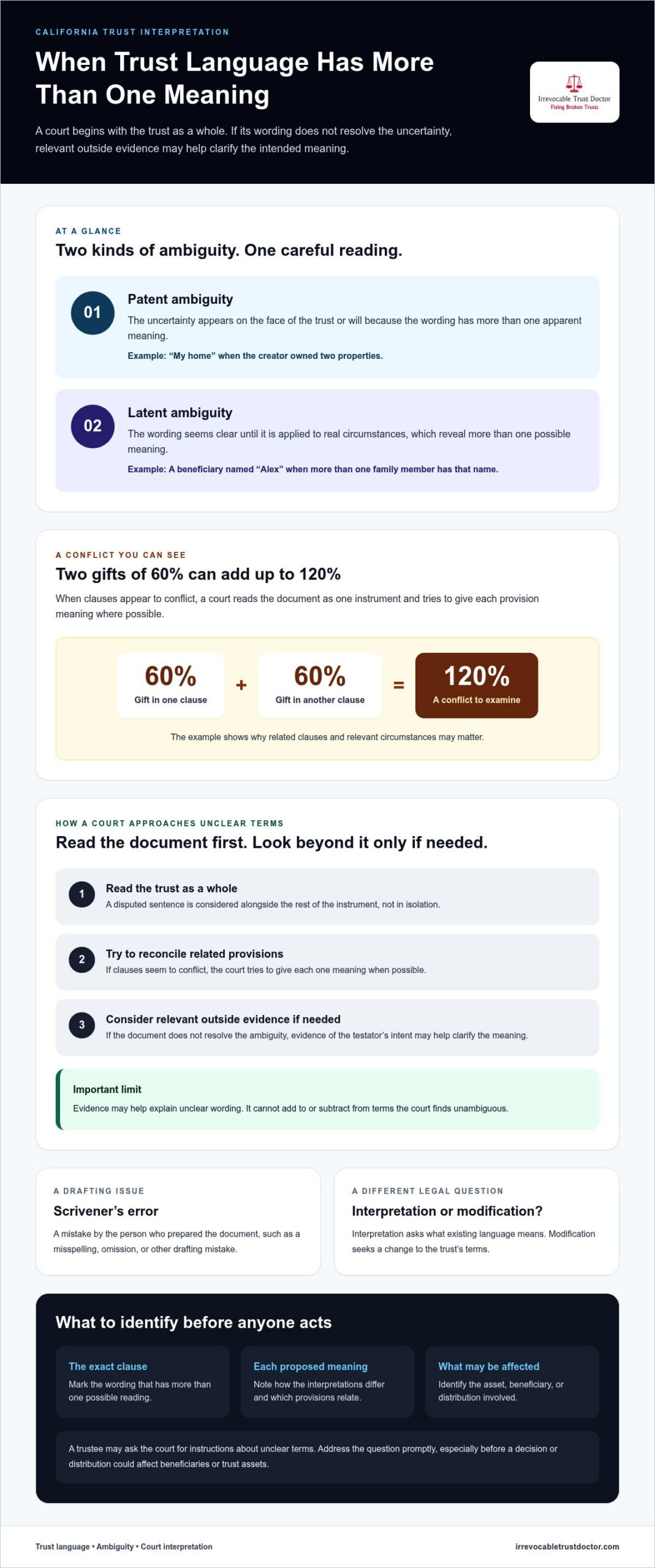
A court reads the will or trust as one instrument, rather than isolating a disputed sentence. If two clauses appear to conflict, the court tries to give each meaning when possible. For example, two gifts of 60% each would dispose of 120% of an estate. That conflict may require examining related clauses and relevant circumstances.
How do courts interpret ambiguous wills and trusts?
If the document itself does not resolve an ambiguity, a California court may consider evidence of the testator’s intent. For example, evidence that someone repeatedly used a word in a particular way may help clarify its meaning. A court may also overlook a minor drafting error when the original intent is clear. However, evidence cannot add to or subtract from terms the court finds unambiguous.
If an unclear gift remains unresolved, the assets may pass to the decedent’s heirs under California intestacy laws. This possibility makes the exact wording and available evidence important to estate administration.
How can someone petition for trust interpretation?
There is no single California deadline for every request to interpret a trust. Timing depends on the circumstances, including whether the uncertainty affects an upcoming decision or distribution. Address the question promptly, before taking action that could affect beneficiaries or trust assets.
A trustee may file a Petition for Instructions asking the court to address unclear terms. The petition identifies the disputed language and the interpretation question needing resolution. If you’re preparing to ask the court for guidance, a trust petition consultation can help clarify the issue and next steps.
What is the legal meaning of ambiguous language?
A patent ambiguity exists when wording on the face of a will or trust has more than one apparent meaning. For example, “my home” may be unclear if the document’s creator owned two properties. A latent ambiguity emerges only when the words are applied to real circumstances. A beneficiary named “Alex,” for instance, could be more than one person in the family. Identifying the type of ambiguity helps define the question that needs to be resolved.
Not every drafting problem has the same legal effect. A scrivener’s error is a mistake made by the person who prepared the document, such as a misspelling, omission, or other drafting mistake. Compare the disputed language with surrounding provisions, then identify the specific asset, beneficiary, or distribution affected. This can help distinguish a question of interpretation from a request to change the trust’s terms.
Intent matters, but it must be considered in connection with the document and relevant circumstances. If an unclear term refers to a surviving spouse, for example, the family’s use of that term may help explain its meaning. Evidence that the testator repeatedly used a word in a particular way may also clarify intent. Beneficiaries may disagree about the interpretation, so identify the exact clause and each proposed reading. That gives a consultation a focused starting point.
If unclear wording in an irrevocable trust raises a possible need for modification, book a trust petition consultation to discuss whether an Irrevocable Trust Modification Petition may fit. Interpretation and modification address different problems: one asks what existing language means, while the other seeks a change.
The Irrevocable Trust Doctor: Irrevocable Trust Modification Petition
The Irrevocable Trust Doctor, a service of attorney Robert P. Bergman, Board-Certified Specialist in Estate Planning, Trust, and Probate Law (California State Bar Board of Legal Specialization), assists with uncontested trust modification petitions. If interpreting unclear wording shows that an irrevocable trust may need a change, an Irrevocable Trust Modification Petition may be the relevant next step. A petition seeks modification, not simply a court’s interpretation of existing terms.
Families, attorneys, and their clients throughout California can receive assistance with uncontested ex parte petitions in the Santa Clara County Probate Court, regardless of the county where the trust is located. These petitions are filed under Probate Code Section 15403 or Probate Code Section 15409, as applicable. Santa Clara County petitions are typically granted in 7 to 10 days. The practice handles only uncontested ex parte petitions, not contested matters.
If you are unsure whether the issue calls for interpretation or modification, contact The Irrevocable Trust Doctor about a Trust Petition Consultation.
Move From Uncertainty to a Defined Decision
An unresolved interpretation can shape decisions about trust property and affect relationships among beneficiaries. Before taking the next step, write down the specific decision that cannot safely be made, the possible interpretations, and what depends on that decision. This gives the discussion a practical focus.
A lawyer for ambiguous trust language in San Francisco can help define the issue and distinguish uncertainty about meaning from a requested change to the trust. Bring the relevant document and note which decision remains unresolved. A focused conversation can clarify what question needs attention and whether a petition is relevant.
Arrange a focused consultation to discuss the trust issue. A clear, manageable next step can help you move forward with greater confidence.
Frequently Asked Questions
Interpreting a Will or Trust?
A will or trust should be interpreted in context, not by relying on one phrase alone. If a family member’s name or an asset description seems unclear, note the exact wording and the decision it affects. Keep signed copies and amendments together so the document history is clear before anyone distributes property or acts on an uncertain direction.
What Is Ambiguous Language in Law?
Ambiguous language is wording that can reasonably have more than one meaning. For example, a trust might refer to “the family home” when its creator owned a house and a condominium. The practical question is whether the document and relevant context point to one meaning. Identifying the competing interpretations helps clarify what needs resolution and the possible consequences of each reading.
Searching for a Trust Lawyer?
Seek legal guidance suited to the issue. If you are unsure whether unclear wording also calls for changing an irrevocable trust, a Trust Petition Consultation can assess the feasibility of a modification petition. Before the consultation, gather the trust and amendments, identify the clause at issue, and write down what change you believe may be needed.
What Is Extrinsic Evidence and How Can It Help?
Extrinsic evidence is information outside the will or trust. It may include a draft, a letter, or information about how the creator used a particular phrase. For instance, a letter that consistently calls a particular account “the education fund” may provide context for that wording. Organize relevant records by date and connect each item to the language it may help clarify.
How Does California Law Interpret Ambiguous Trust Provisions?
California courts first examine the trust’s language and related provisions. If those terms do not resolve the uncertainty, a court may consider outside evidence to clarify the creator’s intent. For example, evidence about someone’s repeated personal use of a name may help distinguish between beneficiaries with similar names. The clause and its supporting context shape the interpretation.

Article by
Robert P. Bergman, Attorney at Law
Attorney Robert P. Bergman ("Bob Bergman") has been a Board-Certified Specialist in Estate Planning, Trust and Probate Law since 2011, as certified by the California State Bar Board of Legal Specialization. For several years, Bob has assisted families and the clients of other attorneys with obtaining court orders through trust modification petitions to make necessary modifications to existing irrevocable trusts. Bob is friendly, very approachable, and believes in explaining complex legal topics in clear ordinary language so that his clients understand exactly what they're doing and why they're doing it.
Bob is often able to assist clients throughout California who are in other counties than his home county of Santa Clara through his approach to trust modification petitions.