
Disclaimer
This article is for informational purposes only. Nothing in this article is intended to replace legal advice from a competent attorney or be considered legal guidance for anybody's specific legal situation. Nobody should rely on information in this article in making legal decisions without such consultation.
Trust modification for special needs beneficiaries may be possible in California when a legal ground supports the proposed change and the court approves it. A modification can address a beneficiary’s needs while taking public-benefit planning into account, but it cannot guarantee eligibility for benefits such as SSI or Medi-Cal.
Questions about consent, court involvement, and potential effects on benefits are understandable. I assist families, attorneys, and their clients throughout California with uncontested ex parte trust modification petitions filed in Santa Clara County Probate Court, regardless of the county where the trust is located. These petitions are typically granted in 7 to 10 days.
Key Takeaways
- A proposed trust change should respond to the beneficiary’s circumstances while remaining consistent with the trust’s purposes.
- Trust modification for special needs beneficiaries may involve different legal grounds, including beneficiary consent or changed circumstances, depending on the facts.
- Review the trust documents and assess consent and legal grounds before preparing an uncontested petition.
- Families, attorneys, and clients throughout California can pursue qualifying uncontested petitions in Santa Clara County Probate Court, regardless of where the trust is located.
What should trust modification for a special needs beneficiary accomplish?
Modification is not automatic. A proposed change should address the beneficiary’s current circumstances while respecting the purposes for which the trust was created. The goal is a legally supported adjustment, not simply a rewrite of terms that have become inconvenient.
Trust modification means changing specific terms of an existing trust, often through a court petition, to better address a beneficiary’s needs. For example, a petition might seek to adjust how the trustee may use or manage funds. The appropriate change depends on the trust language and the facts, and it cannot guarantee eligibility for Supplemental Security Income, Medi-Cal, or other public benefits.
A Special Needs Trust is generally intended to hold and manage assets for a person with disabilities in a way designed to supplement, rather than replace, other support. Whether a proposed trust change serves that purpose depends on its precise terms and the rules of the relevant benefit program.
What should families review before proposing a trust change?
Start by identifying the exact trust provision causing concern and the practical result you hope to achieve. Is a distribution term difficult to apply to the beneficiary’s needs? Has a change in circumstances made the trust’s original structure less suitable? Benefit consequences depend on the trust language, the beneficiary’s individual facts, and applicable program rules, so do not assume a change will preserve eligibility.
Gather the complete trust, every amendment, and relevant correspondence for legal review. Note questions about the trustee’s discretion, distribution terms, and the beneficiary’s needs. This preparation helps focus the review on a specific proposed change and its intended purpose.
Which California Probate Code provisions may support a trust modification?
Probate Code Section 15403 and Probate Code Section 15409 may provide separate legal grounds for modifying an irrevocable trust. Which provision may apply depends on the trust’s terms, the people affected, and the facts. Neither section guarantees court approval.
How do consent and changed circumstances affect the legal analysis?
Probate Code Section 15403 addresses modification with the consent of all beneficiaries, provided the change does not defeat a material purpose of the trust. In practical terms, the analysis considers whether all beneficiaries consent and whether the proposed change conflicts with an important objective the trust was designed to achieve.
Probate Code Section 15409 addresses circumstances that were not anticipated when the trust was created and that would defeat or substantially impair its purposes. A beneficiary’s changed needs may be relevant, but the court must assess the evidence and the trust’s specific objectives. The complete trust and case facts need to be reviewed against the applicable statutory requirements.
For trust modification for special needs beneficiaries, the legal analysis and any public-benefit implications are distinct questions. The California Department of Health Care Services’ information on Special Needs Trusts offers general background, but it does not determine how a particular trust or proposed amendment will be treated.
An uncontested ex parte petition is not the same as a contested court matter. “Ex parte” means seeking a court order through a procedure that does not involve a formal hearing. It does not remove the need to establish a legal basis or meet court requirements. If beneficiaries disagree or the petition is opposed, the matter is not uncontested. A trust petition consultation can help assess whether an uncontested petition may fit the trust and circumstances.
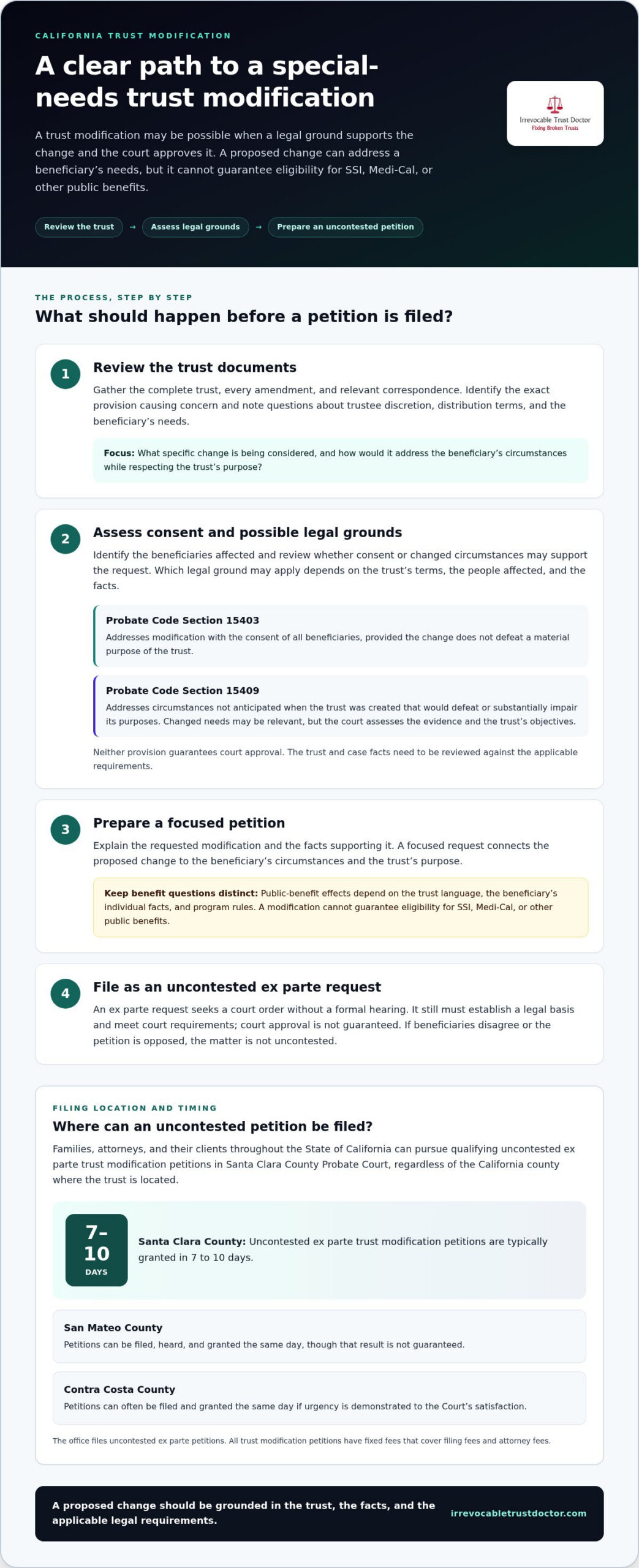
How can California families pursue an uncontested ex parte trust petition?
Families, attorneys, and their clients can pursue an uncontested ex parte petition when the facts support a legal basis and the matter is not opposed. The process starts with reviewing the trust and ends with filing a petition that explains the requested change and its grounds.
- Review the documents. Gather the trust, amendments, and records that help explain the beneficiary’s circumstances and the proposed change.
- Assess consent and legal grounds. Identify the affected beneficiaries and consider whether consent or changed circumstances may support the request.
- Prepare the petition. Explain the requested modification and supporting facts clearly, with the goal of proceeding on an uncontested basis.
- File the petition. An ex parte request is submitted without a formal hearing. Court requirements still apply, and approval is not guaranteed.
I assist families, attorneys, and clients throughout the State of California with uncontested ex parte trust modification petitions under Probate Code Section 15403 and Probate Code Section 15409. Petitions are filed in Santa Clara County Probate Court, regardless of where the trust is located. I serve clients across the San Francisco Bay Area, Northern California, Southern California, the Central Valley, and San Diego, including families and attorneys in Alameda, San Francisco, Los Angeles, Orange, San Bernardino, Sacramento, and Fresno Counties.
What should families expect from the local filing process?
I also regularly file in San Mateo and Contra Costa Counties. In San Mateo County, petitions can be filed, heard, and granted the same day, though that result is not guaranteed. In Contra Costa County, petitions can often be filed and granted the same day if urgency is demonstrated to the Court’s satisfaction.
All trust modification petitions have fixed fees covering filing fees and attorney fees. Review the fixed trust petition fees as you consider next steps. A trust petition consultation can help assess whether an uncontested petition may fit the trust and circumstances.
Take the next step with a clear plan
A focused review can turn uncertainty into a practical next step. Before proceeding, write down the change you hope to make, why it matters to the beneficiary now, and any questions about the trust’s terms or petition process. This gives the legal review a clear starting point and keeps the proposed solution tied to the beneficiary’s circumstances.
Trust modification for special needs beneficiaries calls for careful judgment, especially when public-benefit planning is part of the family’s concern. Robert P. Bergman is a Certified Specialist in Estate Planning, Trust, and Probate Law. A consultation can help assess whether an uncontested petition may fit the trust and facts. Schedule a trust petition consultation to discuss a path forward with The Irrevocable Trust Doctor. Bring the trust documents and a clear description of the change you are seeking.
Frequently Asked Questions
Is a special needs trust the same thing as modifying an irrevocable trust?
No. A Special Needs Trust describes a trust arrangement; modifying an irrevocable trust describes a court process for changing existing terms. A petition might request terms intended to support a special-needs planning goal, but the label alone does not determine the trust’s legal or benefits treatment. Focus on the exact language proposed, not just the name used for the arrangement.
Can changing a trust guarantee that a beneficiary will keep SSI or Medi-Cal benefits?
No change can guarantee that result. Identify the specific benefit at issue and consider how the proposed trust language could affect the beneficiary under that program’s rules. For example, consider whether the change concerns who controls distributions or how funds may be used. Approval of a trust modification and a benefits eligibility decision are separate matters.
Does a beneficiary’s disability automatically qualify an irrevocable trust for modification?
No. A diagnosis by itself does not establish that a court will modify the trust. The petition must connect the requested change to a legal ground and explain why the existing terms warrant court review. Organize records that show the beneficiary’s needs and explain how the proposed terms relate to the trust’s objectives.
Do trust modification petitions have fixed fees?
Yes. Trust modification petitions have fixed fees that cover filing fees and attorney fees. A fixed fee does not mean every proposed change qualifies for court approval. Review the fee information alongside the specific request, and consider the petition’s legal basis separately from its fees.

Article by
Robert P. Bergman, Attorney at Law
Attorney Robert P. Bergman ("Bob Bergman") has been a Board-Certified Specialist in Estate Planning, Trust and Probate Law since 2011, as certified by the California State Bar Board of Legal Specialization. For several years, Bob has assisted families and the clients of other attorneys with obtaining court orders through trust modification petitions to make necessary modifications to existing irrevocable trusts. Bob is friendly, very approachable, and believes in explaining complex legal topics in clear ordinary language so that his clients understand exactly what they're doing and why they're doing it.
Bob is often able to assist clients throughout California who are in other counties than his home county of Santa Clara through his approach to trust modification petitions.