
Disclaimer
This article is for informational purposes only. Nothing in this article is intended to replace legal advice from a competent attorney or be considered legal guidance for anybody's specific legal situation. Nobody should rely on information in this article in making legal decisions without such consultation.
A California court may remove a trustee when the facts and applicable law support that request. A petition to replace trustee irrevocable trust California asks to change who manages the trust, while a trust-modification petition asks to change the trust’s terms. The right court action depends on what happened and what result you are seeking.
If you’re concerned about how trust assets are being managed, start by organizing the facts and identifying the specific court action you want. This article explains how to distinguish a trustee change from a trust modification, including when an uncontested trust-modification petition may offer a path forward.
Key Takeaways
- Organize the trust and amendments, a timeline of events, relevant communications, and available account records to clarify your concerns.
- Define the result you’re seeking: changing the trustee and changing the trust’s terms are different legal questions.
- A petition to replace trustee irrevocable trust California depends on the specific facts and applicable law, so identify the concern and requested court action clearly.
- An uncontested ex parte trust-modification petition under Probate Code Section 15403 or Probate Code Section 15409 may address certain changes to trust terms, but it is not a trustee-replacement petition.
What Does a Petition to Replace a Trustee in California Address?
A petition to replace a trustee asks a court to remove the person serving in that role when the facts and applicable law support the request. In California, Probate Code Section 15642 identifies potential grounds for removal, but a concern by itself does not establish that a court will grant a petition.
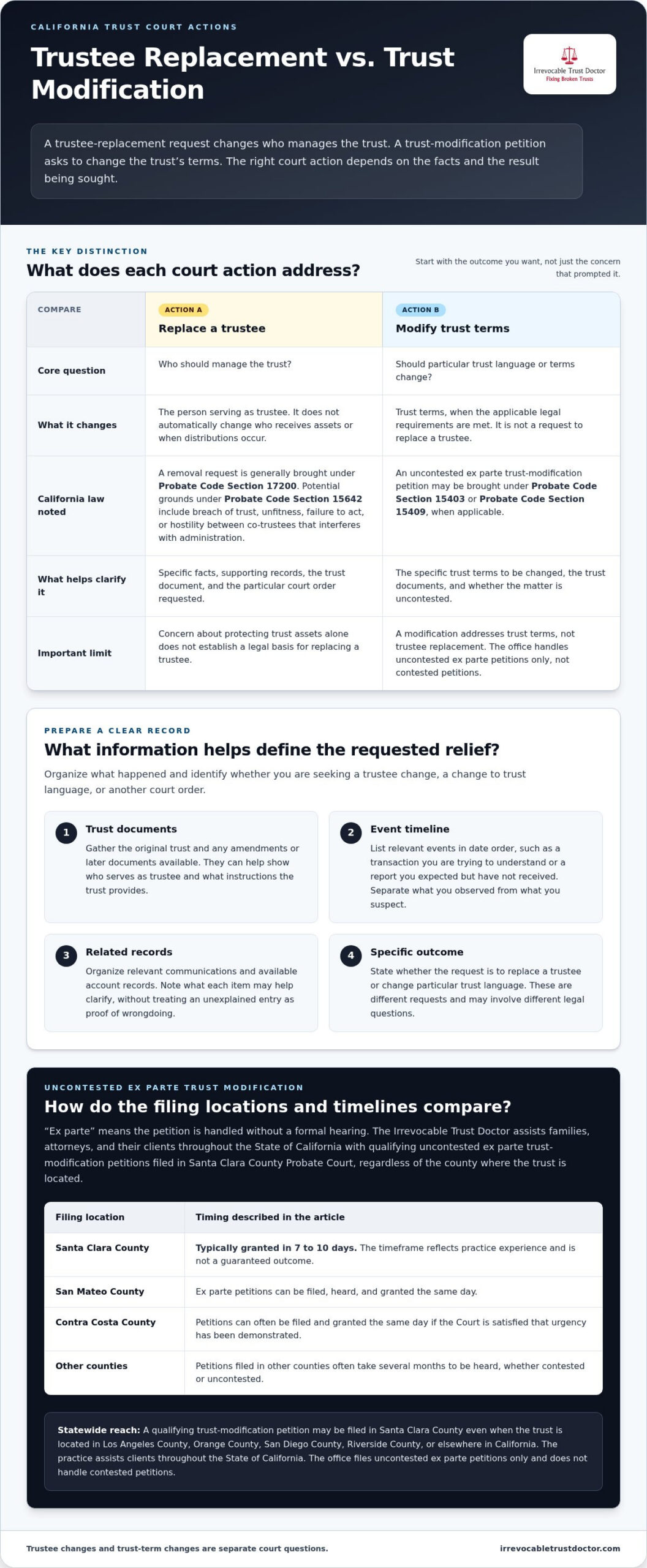
A trustee-replacement petition addresses who manages the trust. It does not automatically change the trust’s terms, such as who receives assets or when distributions occur. A request to change those terms raises a separate legal question. The principles of trust law provide general background, but the trust document and California law guide the specific analysis.
When Does Concern About a Trustee Call for Legal Review?
Start with observable events rather than conclusions about intent. For example, record a transaction you can’t reconcile, a report you expected but haven’t received, or a lapse in asset protection. Note the date, amount if known, asset involved, and any relevant trust language or communications. This creates a clearer record of what happened without treating a concern as proven misconduct.
A removal request is generally brought under Probate Code Section 17200, which allows a court to address a trust’s internal affairs. Potential grounds under Probate Code Section 15642 include breach of trust, unfitness, failure to act, or hostility between co-trustees that interferes with administration. The trust document, supporting facts, and specific order requested all shape the legal analysis.
Concern about protecting trust assets alone does not establish a legal basis for replacing a trustee. If you’re assessing a petition to replace trustee irrevocable trust California, organize the records and identify whether you’re seeking a trustee change, a change to trust language, or another court order. That distinction helps focus the next steps.
How Can You Prepare Before Seeking a California Trust Petition?
Good preparation starts with a clear record of what happened and a precise description of the court action you want. The materials can help distinguish a trustee change from a change to the trust’s terms, but the legal grounds and supporting evidence require case-specific review. No collection of documents can guarantee that a court will grant relief.
- Gather the trust documents. Include the original trust and any amendments or later documents you have. They can help show who serves as trustee and what authority or instructions the trust provides.
- Build a timeline. List relevant events in date order, such as a transaction you’re trying to understand or a report you expected but haven’t received. Separate what you directly observed from what you suspect.
- Collect related records. Organize relevant communications and available account records, noting what each item may help clarify. Avoid treating an unexplained entry as proof of wrongdoing.
- Name the outcome you want. State whether you’re asking to replace a trustee or change particular trust language. These are distinct requests and may involve different legal questions.
What Information Helps Clarify the Requested Court Relief?
Arrange records by date and label each with the concern it may help explain. The people named in the trust, including beneficiaries and trustees, and the trust’s specific terms may affect the analysis. An overview of irrevocable trusts can provide general background, but it does not determine what relief fits a particular trust or set of facts.
If you’re unsure how to frame questions about a possible trust modification, a trust petition consultation can help you organize the issue. Bring the trust documents, timeline, communications, and account records you’ve gathered.
How Does an Uncontested Ex Parte Trust-Modification Petition Work in California?
An uncontested ex parte trust-modification petition asks the court to approve a change to an irrevocable trust when the applicable legal requirements are met and the matter is uncontested. “Ex parte” means the petition is handled without a formal hearing. The Irrevocable Trust Doctor assists attorneys, families, and their clients with trust-modification petitions under Probate Code Section 15403 or Probate Code Section 15409 when applicable. This process addresses trust terms, not a request to replace a trustee.
Robert P. Bergman assists attorneys, families, and clients throughout the State of California by filing uncontested ex parte trust-modification petitions in Santa Clara County Probate Court, regardless of the county where the trust is located. The practice serves clients across the San Francisco Bay Area, Northern California, Southern California, the Central Valley, San Diego, Sacramento, Fresno, Bakersfield, Greater Los Angeles, Orange County, Riverside County, and San Bernardino County.
Uncontested ex parte petitions filed in Santa Clara County are typically granted in 7 to 10 days. In San Mateo County, ex parte petitions can be filed, heard, and granted the same day. In Contra Costa County, petitions can often be filed and granted the same day if the Court is satisfied that urgency has been demonstrated. These timeframes reflect the practice’s experience and are not guaranteed outcomes.
Could a Trust Located Outside Santa Clara County Use This Filing Approach?
Yes. A qualifying uncontested trust-modification petition may be filed in Santa Clara County even if the trust is located in Los Angeles County, Orange County, or elsewhere in California. The practice also assists families, attorneys, and clients in counties including Alameda, San Francisco, Marin, Ventura, Santa Cruz, Sacramento, Placer, Santa Barbara, San Joaquin, Fresno, Solano, San Luis Obispo, and Monterey. Petitions filed in other counties often take several months to be heard, whether contested or uncontested. The office files uncontested ex parte petitions only and does not handle contested petitions.
Before considering this route, identify whether the requested court action would change trust terms or replace a trustee. A petition to replace trustee irrevocable trust California is not automatically a trust-modification petition, and the procedures are not interchangeable. Fixed fees for trust-modification petitions cover filing fees and attorney fees. Details are available on the trust petition fees and costs page.
Choose a Next Step That Fits the Concern
Before moving forward with a petition to replace trustee irrevocable trust California, turn your concern into a focused question: what court action would address the issue, and what records support asking for it? A clear request helps keep the next step tied to the trust’s actual circumstances rather than assumptions about what may have happened.
If you’re unsure whether the situation involves a trustee change or a possible modification of trust terms, bring that distinction to a trust petition consultation. Robert P. Bergman is a Certified Specialist in Estate Planning, Trust, and Probate Law. He can evaluate whether an uncontested trust-modification petition may fit the facts and explain the petition process.
Schedule a trust petition consultation to discuss whether an uncontested trust-modification petition fits your situation.
Frequently Asked Questions
Can a beneficiary replace a trustee without the trustee’s agreement?
A beneficiary may ask a California court to remove a trustee without the trustee’s agreement. If the trustee objects, the matter may become contested and require a formal, noticed court process. The Irrevocable Trust Doctor files uncontested ex parte trust-modification petitions, which address changes to trust terms rather than contested requests to replace a trustee.
What records should I organize if I am concerned about trust assets?
For each transaction you’re trying to understand, note the date, amount, account or asset involved, and the question it raises. Compare entries across statements when available, and mark any missing periods or unexplained changes. Keep copies in a consistent order so the sequence is easy to follow, and preserve the original records without adding notes directly to them.
Does replacing a trustee automatically change the terms of an irrevocable trust?
No. Replacing a trustee does not, by itself, revise the written trust provisions. A separate change to those provisions must be addressed through its own appropriate legal process. For example, a new trustee does not automatically gain authority to change beneficiaries’ distribution terms merely by taking over management.
What do fixed fees for an uncontested trust-modification petition cover?
Fixed fees for trust-modification petitions cover court filing fees and attorney fees. This fee arrangement applies to the modification petition itself, not necessarily to a different type of court request. The petition’s purpose matters, so identify whether the requested relief is a trust modification before relying on this fee information.

Article by
Robert P. Bergman, Attorney at Law
Attorney Robert P. Bergman ("Bob Bergman") has been a Board-Certified Specialist in Estate Planning, Trust and Probate Law since 2011, as certified by the California State Bar Board of Legal Specialization. For several years, Bob has assisted families and the clients of other attorneys with obtaining court orders through trust modification petitions to make necessary modifications to existing irrevocable trusts. Bob is friendly, very approachable, and believes in explaining complex legal topics in clear ordinary language so that his clients understand exactly what they're doing and why they're doing it.
Bob is often able to assist clients throughout California who are in other counties than his home county of Santa Clara through his approach to trust modification petitions.