
Disclaimer
This article is for informational purposes only. Nothing in this article is intended to replace legal advice from a competent attorney or be considered legal guidance for anybody's specific legal situation. Nobody should rely on information in this article in making legal decisions without such consultation.
What if a trust can still be changed after the person who created it has died? A death may make a trust irrevocable, but that does not automatically close every path to a needed correction. Whether modifying a trust after death in California is possible depends on the trust’s terms, the circumstances, and the legal basis for the requested change.
If you are unsure whether beneficiary consent is needed or a court petition may help, it can be difficult to sort through the options. This guide explains how Probate Code Sections 15403 and 15409 may apply, what makes a petition uncontested, and which documents and details to prepare for a consultation. I assist families, attorneys, and their clients throughout the State of California with uncontested ex parte trust modification petitions filed in Santa Clara County, regardless of where the trust is located. An ex parte petition is a court request handled without a formal hearing.
Key Takeaways
- Death alone does not determine whether a trust can be changed. Review the trust’s terms, who is involved, and the specific change being considered.
- When modifying a trust after death in California, Probate Code Section 15403 and Probate Code Section 15409 may provide different paths for court review, depending on consent and the circumstances.
- To prepare, gather the complete trust and its amendments, describe the proposed change, and identify the people involved and their positions.
- Families, attorneys, and clients throughout the State of California can pursue uncontested ex parte petitions in Santa Clara County, regardless of where the trust is located. Petitions there are typically granted in 7 to 10 days.
Can a Trust Be Modified After Death in California?
Yes, a trust may be modifiable after the person who created it dies, but death alone does not settle the question. The trust’s terms, the people involved, and the requested change all matter. A beneficiary cannot simply rewrite the document. If a change may be appropriate, a court petition can ask the court to approve it under a legal basis that fits the circumstances.
Trust rules are handled at the state level, so the governing state’s law matters. The overview of United States trust law offers broader context, but California law and the trust document guide the specific analysis here.
Why the trust document and the timing of death matter
Start by gathering the complete trust and every amendment. Make a short list identifying the settlor, the person who created the trust; the trustee, who manages it; and the beneficiaries, who may receive its benefits. Also note whether a settlor is still living. If there were two settlors, record whether one or both have died. These details can affect who may seek a change and which legal pathway may apply.
Then compare the relevant trust provisions with the change being proposed. A request to address an administrative problem may raise different questions from a request that would change who benefits or how the trust operates. For broader context on California law, see this California trust modification guide.
Modifying a trust after death in California calls for a focused review, not an assumption that the trust is either permanently fixed or freely changeable. I assist families, attorneys, and their clients throughout the State of California with uncontested ex parte petitions filed in Santa Clara County, regardless of where the trust is located. This includes clients and counsel in the San Francisco Bay Area, Northern California, Southern California, the Central Valley, San Diego, Sacramento, Fresno, Bakersfield, Greater Los Angeles, Orange County, Riverside County, and San Bernardino County.
Which California Probate Code Pathways May Apply After a Death?
Two provisions may provide different grounds for court review when modifying a trust after death in California: Probate Code Section 15403 and Probate Code Section 15409. They are not interchangeable, and neither guarantees approval. The trust’s language, the relief requested, the people involved, and the supporting facts all matter.
How consent and changed circumstances affect the analysis
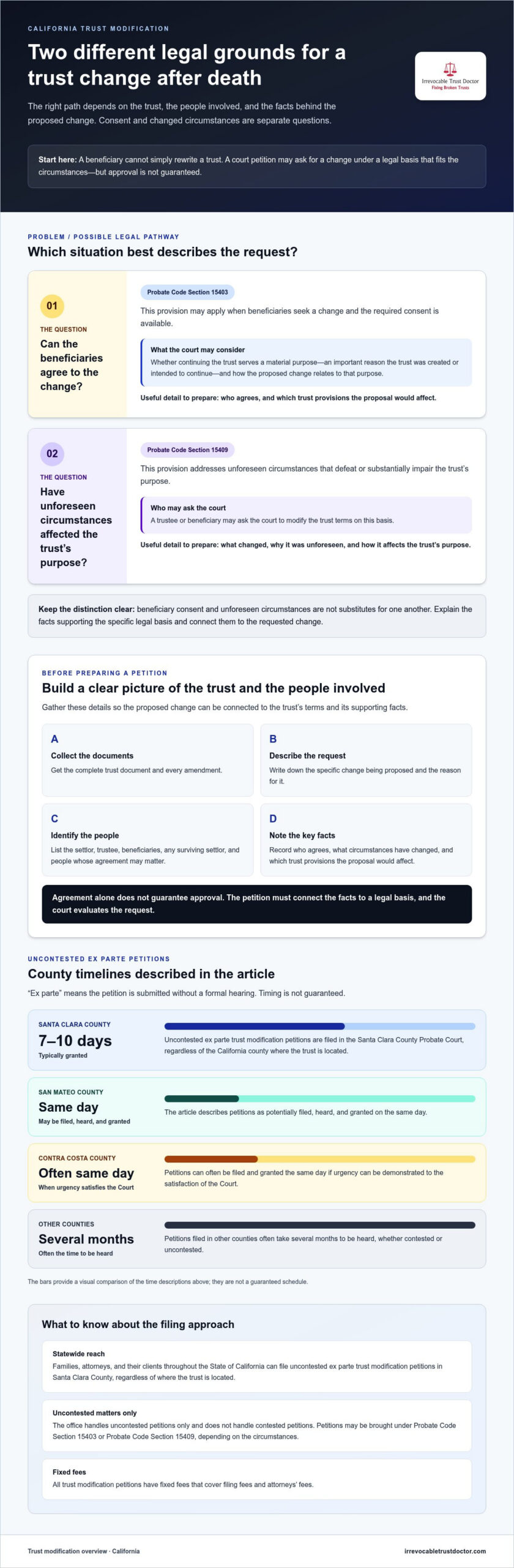
Probate Code Section 15403 may apply when beneficiaries seek a change and the required consent is available. The court may also consider whether continuing the trust serves a material purpose, meaning an important reason the trust was created or intended to continue, and how the proposed change relates to that purpose.
Probate Code Section 15409 addresses a different situation: unforeseen circumstances may defeat or substantially impair the trust’s purpose. A trustee or beneficiary may ask the court to modify the terms on that basis. Review the statute’s language in Probate Code Section 15409.
Consent and changed circumstances are separate questions, not substitutes for one another. A petition should explain the facts supporting its specific legal basis and connect those facts to the requested change. Before a consultation, note who agrees, what circumstances have changed, and which trust provisions the proposal would affect. The court evaluates the petition, and approval cannot be assumed.
I assist families, attorneys, and clients throughout the State of California with uncontested ex parte petitions under Probate Code Sections 15403 and 15409, filed in Santa Clara County regardless of where the trust is located. To discuss which legal pathway may fit the circumstances, schedule a trust petition consultation.
How an Uncontested Ex Parte Trust Petition Can Move Forward
Preparation starts with a clear picture of the trust and the change being requested. Gather the complete trust document and all amendments. Write down the specific change you want the court to consider and the reason for it. Identify the settlor, trustee, beneficiaries, any surviving settlor, and the people whose agreement may matter. A petition must connect the facts to a legal basis. Agreement alone does not guarantee approval.
Some trust changes involve a settlor’s consent, which is different from seeking a post-death change. The text of California Probate Code Section 15404 addresses a separate statutory route. The relevant provision depends on the trust’s circumstances and the relief requested.
What to expect from county-specific filing and a consultation
I assist families, attorneys, and their clients throughout the State of California with uncontested ex parte trust modification petitions filed in the Santa Clara County Probate Court, regardless of where the trust is located. “Ex parte” means the petition is submitted without a formal hearing. Our office handles uncontested petitions only.
Santa Clara County petitions are typically granted in 7 to 10 days, though timing is not guaranteed. In San Mateo County, petitions may be filed, heard, and granted the same day. Contra Costa County petitions can often be filed and granted the same day if urgency satisfies the Court. Petitions filed in other counties often take several months to be heard.
All trust modification petitions have fixed fees that cover filing fees and attorneys’ fees. Review the trust petition fees and costs, then book a trust petition consultation to discuss the trust documents, proposed change, and next steps for modifying a trust after death in California.
Take the Next Step Toward a Clear Path Forward
Whether a trust can be changed after death depends on its terms, the people involved, and the reason for the proposed change. Probate Code Sections 15403 and 15409 provide distinct grounds for court review, but neither makes approval automatic. Reviewing the trust and relevant circumstances can help clarify which path may fit.
For families, attorneys, and clients throughout the State of California, I file uncontested ex parte trust modification petitions in Santa Clara County, regardless of where the trust is located. Robert P. Bergman is a Certified Specialist in Estate Planning, Trust, and Probate Law. Fixed petition fees cover filing fees and attorneys’ fees.
If you are considering modifying a trust after death in California, gather the trust and its amendments and write down the change you want to request. Then book a trust petition consultation to discuss the circumstances and practical next steps.
Frequently Asked Questions
Can a trust be modified after the settlor dies in California?
Yes, modifying a trust after death in California may be possible when the facts and a legal basis support the requested change. Probate Code Section 15403 may involve beneficiary consent; Probate Code Section 15409 addresses certain changed circumstances. The trust’s language, the people involved, and the proposed modification matter. The court must approve a petition, and approval is not automatic.
Does a trust automatically become unchangeable when someone dies?
No. A settlor’s death does not, by itself, answer whether a trust can be changed. A trust may become irrevocable, meaning no single person can simply change it unilaterally, yet California law may allow a court to modify its terms in qualifying circumstances. Review the trust and amendments to identify who created it, who serves as trustee, and what powers or limits the document states.
Can beneficiaries change a trust without going to court?
Beneficiaries should not assume they can rewrite trust terms just because they agree. Consent may be relevant, but it does not automatically authorize a change without court involvement. Under Probate Code Section 15403, beneficiaries may petition the court when its requirements may apply; Probate Code Section 15409 provides a separate basis tied to changed circumstances. Gather the trust, note the beneficiaries’ positions, and identify the specific change being requested.
How long can an uncontested trust modification petition take in California?
An uncontested ex parte petition in Santa Clara County is typically granted in 7 to 10 days, but timing is not guaranteed. San Mateo petitions may be filed, heard, and granted the same day; Contra Costa petitions can often be granted the same day if urgency satisfies the Court. Petitions filed in other counties often take several months. The practice serves the San Francisco Bay Area, Northern California, Southern California, Central Valley, San Diego, Sacramento, Fresno, Bakersfield, Greater Los Angeles, Orange County, Riverside County, and San Bernardino County.

Article by
Robert P. Bergman, Attorney at Law
Attorney Robert P. Bergman ("Bob Bergman") has been a Board-Certified Specialist in Estate Planning, Trust and Probate Law since 2011, as certified by the California State Bar Board of Legal Specialization. For several years, Bob has assisted families and the clients of other attorneys with obtaining court orders through trust modification petitions to make necessary modifications to existing irrevocable trusts. Bob is friendly, very approachable, and believes in explaining complex legal topics in clear ordinary language so that his clients understand exactly what they're doing and why they're doing it.
Bob is often able to assist clients throughout California who are in other counties than his home county of Santa Clara through his approach to trust modification petitions.