
Disclaimer
This article is for informational purposes only. Nothing in this article is intended to replace legal advice from a competent attorney or be considered legal guidance for anybody's specific legal situation. Nobody should rely on information in this article in making legal decisions without such consultation.
Can one beneficiary stop a proposed trust change simply by withholding consent? Not necessarily. A California trust modification without all beneficiaries agreeing may still be possible, but a missing signature is not the same as an active objection. Neither fact alone determines the outcome. The legal basis for the change, the trust’s terms, and the beneficiaries’ circumstances all matter.
Probate Code Section 15403 addresses petitions where all beneficiaries consent. Section 15409 may apply when circumstances the person who created the trust did not anticipate affect the trust’s purposes. This article explains how those legal paths differ, what to clarify before proceeding, and why a genuinely uncontested petition is different from a dispute. The Irrevocable Trust Doctor assists families, attorneys, and clients throughout California with uncontested ex parte trust modification petitions filed in Santa Clara County, including for trusts located in Los Angeles County, Orange County, and elsewhere. A Trust Petition Consultation can help assess whether this process may fit your situation.
Key Takeaways
- For a California trust modification without all beneficiaries, distinguish a beneficiary who has not consented from one who actively opposes the proposed change.
- Compare the requested change and supporting facts with Probate Code Sections 15403 and 15409. The appropriate legal path depends on the circumstances.
- Clarify whether the petition is genuinely uncontested before proceeding. An active dispute may fall outside the firm’s petition service.
- Families, attorneys, and clients throughout California can ask whether an uncontested ex parte petition filed in Santa Clara County may fit their situation, regardless of where the trust is located.
Can a California Trust Be Modified Without Every Beneficiary’s Consent?
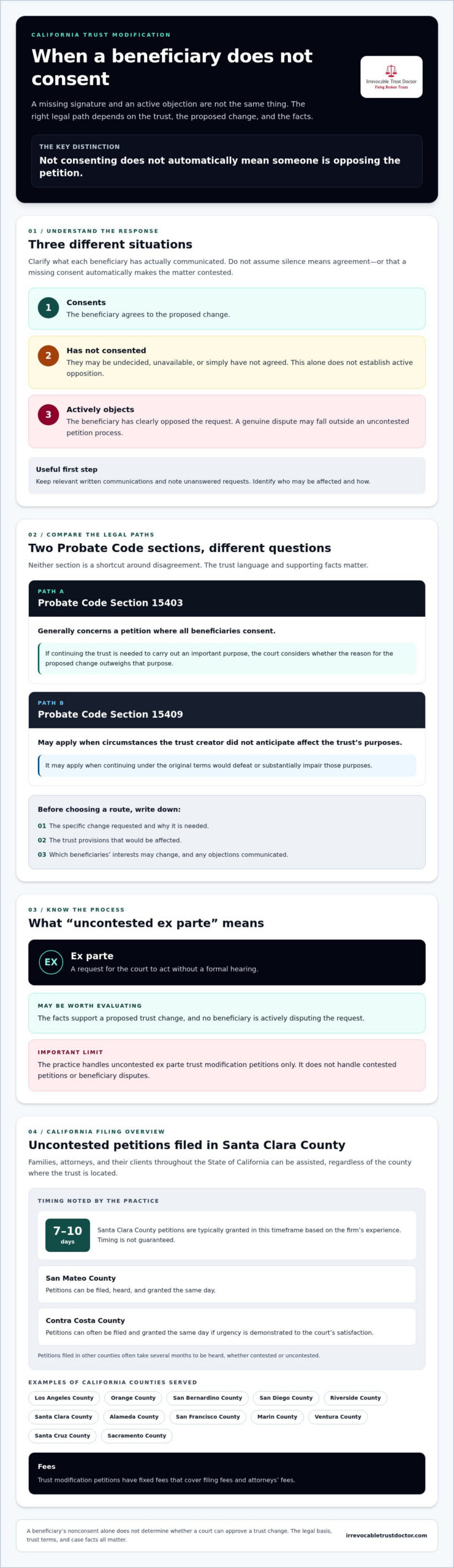
Possibly, but there is no automatic yes or no. Whether a California trust modification without all beneficiaries agreeing can move forward depends on the legal basis for the request, the trust’s terms, and the beneficiaries’ circumstances. A trust is a legal relationship involving roles such as the person who creates it, the person who manages it, and the people who may benefit from it. The effect of a proposed change on those people may matter.
Consent means a beneficiary agrees to the proposed change. Nonconsent means the beneficiary has not agreed, which could mean they are undecided, unavailable, or opposed. Opposition is more specific: the beneficiary has actively objected to the request. These distinctions can help clarify whether a matter is genuinely uncontested. However, a lack of unanimous consent alone does not establish that a court can approve a change or that it will do so.
What does “without all beneficiaries” mean in practice?
Start by identifying what each beneficiary has actually communicated. Has someone not responded, declined to consent, or clearly said they oppose the petition? Keep relevant written communications and note any unanswered requests. Do not assume silence means agreement, or that one person’s lack of consent automatically makes the matter contested.
Also identify who may be affected by the proposed change and how. Notice of the request, how beneficiaries are represented, and the effect on their interests may be relevant. Check the specific legal requirements under the applicable Probate Code section against the facts of the case.
In short: consent requirements depend on the statutory basis for the change and the circumstances of the case.
How Probate Code Sections 15403 and 15409 May Matter
These sections address different legal questions. Probate Code Section 15403 generally concerns a petition where all beneficiaries consent. If continuing the trust is needed to carry out an important purpose, the court considers whether the reason for the proposed change outweighs that purpose. Probate Code Section 15409 may apply when circumstances the person who created the trust did not anticipate make continuing under its original terms defeat or substantially impair the trust’s purposes.
Neither section is a shortcut around disagreement. A beneficiary’s decision not to consent does not, by itself, establish that either legal basis applies or mean the court will approve the requested change. The proposed modification, the trust language, and the supporting facts all matter. You can review the statutory text in the California Probate Code, but have counsel verify the current requirements and how they apply to the specific situation.
Which questions should be reviewed before choosing a legal route?
Before deciding how to proceed, write down the specific change being requested and why it is needed. Identify the trust provisions it would affect, the beneficiaries whose interests may change, and any objections that have been communicated. This creates a clearer record of the facts and gives counsel a basis to assess the appropriate statutory path. For broader context, review a California trust modification guide.
If you are considering a California trust modification without all beneficiaries’ agreement, a Trust Petition Consultation can help assess whether the facts and possible legal basis fit an uncontested petition. The practice assists families, attorneys, and clients throughout California with uncontested ex parte petitions filed in Santa Clara County, regardless of where the trust is located. Explore a Trust Petition Consultation.
When an Uncontested Ex Parte Petition May Be the Next Step
A petition may be worth evaluating if the facts support a trust change and no beneficiary is actively disputing the request. “Ex parte” generally means asking the court to act without a formal hearing. The Irrevocable Trust Doctor handles uncontested ex parte trust modification petitions only. It does not handle contested petitions or beneficiary disputes, so a clear objection may mean the matter falls outside the service.
Families, attorneys, and clients throughout California can be assisted with petitions filed in Santa Clara County, regardless of where the trust is located. Santa Clara County petitions are typically granted in 7 to 10 days based on the firm’s experience, but that timing is not guaranteed. The firm also regularly files in San Mateo County and Contra Costa County. In San Mateo, petitions can be filed, heard, and granted the same day. In Contra Costa, this may often be possible if the court is satisfied that the matter is urgent.
How can you assess whether a consultation is appropriate?
Before a consultation, gather the trust document, a clear description of the proposed change, relevant correspondence, and what you know about each beneficiary’s position. Note who has not responded, who has not agreed, and whether anyone has actively objected. These details can help assess whether an uncontested petition may fit and which legal basis needs closer review. The official California Probate Code Section 15403 is one reference, but the facts and applicable requirements should be reviewed together.
If you are considering a California trust modification without all beneficiaries agreeing, review the trust modification fees and costs, which are fixed and cover filing fees and attorneys’ fees. To discuss whether your matter may qualify, schedule a trust petition consultation.
Take the Next Step With a Clearer Picture
A California trust modification without all beneficiaries agreeing depends on the legal basis, trust terms, and beneficiary circumstances. A beneficiary who has not consented is not necessarily actively opposing the change, but lack of unanimous consent alone does not guarantee court approval. Review the proposed change, the trust, and beneficiary communications together before choosing a next step.
Robert P. Bergman is a Certified Specialist in Estate Planning, Trust, and Probate Law. The practice assists families, attorneys, and clients throughout California with uncontested ex parte trust modification petitions filed in Santa Clara County, regardless of where the trust is located. This includes clients in the San Francisco Bay Area, Northern California, Southern California, the Central Valley, San Diego, Sacramento, Fresno, Bakersfield, Greater Los Angeles, Orange County, Riverside County, and San Bernardino County. The practice handles uncontested petitions only. Fixed fees cover filing fees and attorneys’ fees.
To discuss whether your circumstances may fit this process, schedule a trust petition consultation.
Frequently Asked Questions
Can a California court modify an irrevocable trust if one beneficiary does not agree?
Sometimes, but one beneficiary’s lack of agreement does not automatically allow or prevent a change. The possible path depends on the requested modification, the trust’s terms, and the facts. Probate Code Section 15403 generally addresses petitions with all beneficiaries’ consent, while Probate Code Section 15409 may apply to certain unexpected circumstances affecting the trust’s purposes. Review the specific requirements before proceeding.
Does one beneficiary’s objection make a trust modification petition contested?
An active objection may indicate a dispute, but a beneficiary not signing or responding is not necessarily the same as opposing the request. The details and court process matter. The Irrevocable Trust Doctor handles uncontested ex parte petitions only, not contested petitions or beneficiary disputes. Record what each beneficiary has said, and distinguish a clear objection from a lack of response.
Can a trust modification petition be filed in Santa Clara County if the trust is located elsewhere in California?
The practice assists families, attorneys, and clients throughout California with uncontested ex parte trust modification petitions filed in Santa Clara County, regardless of where the trust is located. This may be relevant for trusts connected to the San Francisco Bay Area, Northern or Southern California, Greater Los Angeles, Orange County, Riverside County, San Bernardino County, San Diego, or the Central Valley, including Sacramento, Fresno, and Bakersfield. Each matter still needs review.
How long does an uncontested ex parte trust modification petition take in Santa Clara County?
Santa Clara County petitions are typically granted in 7 to 10 days, based on the practice’s experience. That timeframe is not guaranteed, and timing can depend on the specific petition and court process. “Ex parte” means the petition is submitted without a formal hearing. Confirm the expected timing for your circumstances during a Trust Petition Consultation.

Article by
Robert P. Bergman, Attorney at Law
Attorney Robert P. Bergman ("Bob Bergman") has been a Board-Certified Specialist in Estate Planning, Trust and Probate Law since 2011, as certified by the California State Bar Board of Legal Specialization. For several years, Bob has assisted families and the clients of other attorneys with obtaining court orders through trust modification petitions to make necessary modifications to existing irrevocable trusts. Bob is friendly, very approachable, and believes in explaining complex legal topics in clear ordinary language so that his clients understand exactly what they're doing and why they're doing it.
Bob is often able to assist clients throughout California who are in other counties than his home county of Santa Clara through his approach to trust modification petitions.