
Disclaimer
This article is for informational purposes only. Nothing in this article is intended to replace legal advice from a competent attorney or be considered legal guidance for anybody's specific legal situation. Nobody should rely on information in this article in making legal decisions without such consultation.
An irrevocable trust is not always beyond correction. Consulting an attorney for a trust modification petition can help you assess whether a drafting mistake, an unexpected change, or circumstances after the settlor’s death may support a court petition in California. Under Probate Code Section 15409, a trustee or beneficiary may petition to modify a trust when unanticipated circumstances would defeat or substantially impair its purposes.
It’s understandable to think “irrevocable” means a trust can never change, especially when its terms no longer fit the circumstances. The key question is whether the facts and the trust’s purpose provide a legal basis for modification.
This article explains how California courts may address drafting mistakes, changes after a settlor’s death, and requests to modify irrevocable trusts, helping you understand when a petition may be appropriate.
Key Takeaways
- Distinguish a request to correct a drafting mistake from one seeking a change because circumstances have shifted; the legal basis and supporting evidence matter.
- A settlor’s death can affect who may change a trust and which legal route may be available, so identify the trust’s status before considering a petition.
- For a California trust petition, the petitioner must give hearing notice at least 30 days before the scheduled hearing, according to California Legislative Information.
- Use a Trust Petition Consultation to assess whether an uncontested ex parte petition under California law may fit your circumstances.
Can a court reform a trust to fix a drafting mistake in California?
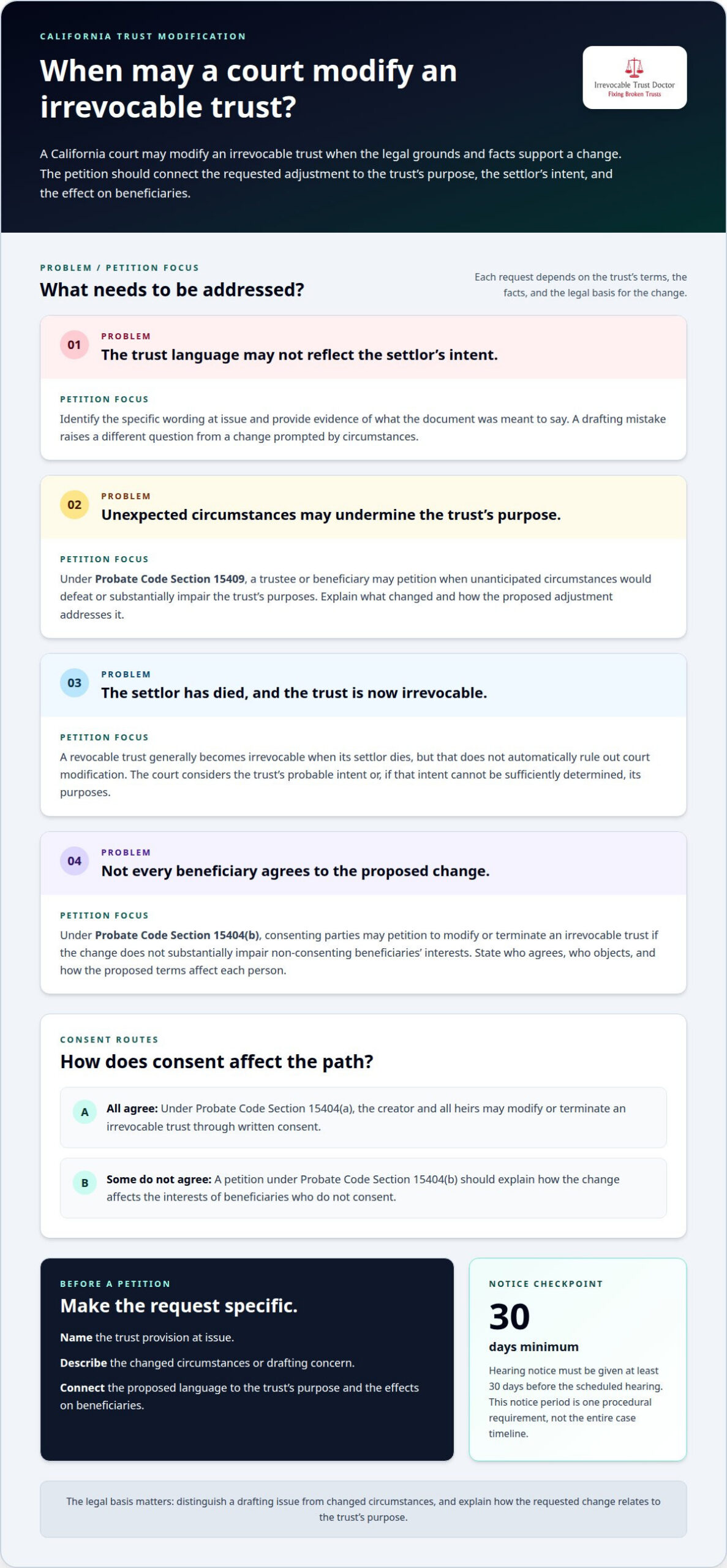
California courts may address trust provisions that do not reflect the settlor’s intent, but the legal basis depends on the problem. A drafting error calls for evidence of what the document was meant to say. Changed circumstances raise a different question: whether the trust can still serve its purpose.
Petitions Without Unanimous Consent
A petition may be available even when beneficiaries do not all agree to a proposed change. Under California Probate Code Section 15404(b), consenting parties may ask the court to modify or terminate an irrevocable trust if the change does not substantially impair non-consenting beneficiaries’ interests. The petition should explain how the proposed provisions affect those beneficiaries. Their interests matter, so disagreement should be addressed directly rather than treated as automatic approval or a complete bar.
Beneficiary Consent and Objections
California provides different consent routes depending on who agrees to the change. Under Probate Code Section 15404(a), the creator and all heirs may modify or terminate an irrevocable trust through written consent. If a beneficiary objects, explain the likely effect on that person and the trust’s purpose. For example, a proposed distribution change should clarify whose interests may shift and why.
Standing to Petition
Standing means having a legally recognized interest that permits someone to ask the court for relief. Under California Probate Code Section 15409, a trustee or beneficiary may petition when unanticipated circumstances would defeat or substantially impair the trust’s purposes. The petitioner’s relationship to the trust helps establish the basis for seeking a court order.
Attorney Roles and Filing Steps
An attorney can examine the trust document, identify the legal ground, and prepare a petition explaining the requested correction. The filing should connect supporting evidence to the specific language at issue and account for affected beneficiaries. California Legislative Information states that hearing notice must be given at least 30 days before the scheduled hearing on a trust petition. The notice period is one procedural requirement, not the entire case timeline.
What Happens to a Trust After the Settlor’s Death?
In California, a revocable trust generally becomes irrevocable when its settlor dies, so the settlor can no longer change its terms. That does not mean a court can never modify it. A petition needs a legal basis connected to the trust’s purpose and the circumstances affecting its administration or beneficiaries.
Start by distinguishing what the trust says from what the settlor likely intended. The signed trust document, amendments, and other relevant records can help explain how a provision was meant to work. For example, if a distribution clause seems inconsistent with the rest of the trust, the question may be whether its language reflects the settlor’s probable intent, not simply whether a beneficiary prefers a different result.
California Probate Code Section 15409 provides a petition route when unanticipated circumstances would defeat or substantially impair the trust’s purposes. After the settlor’s death, the court considers the trust’s probable intent or, if that intent cannot be sufficiently determined, its purposes. A clear explanation of the changed situation can help connect the requested adjustment to that standard.
When Can a Court Modify an Irrevocable Trust?
A California court may modify an irrevocable trust when the legal grounds and facts support a change. Under Probate Code Section 15409, a trustee or beneficiary may petition if unanticipated circumstances would defeat or substantially impair the trust’s purposes, according to California Legislative Information. The requested change should connect to the trust’s original purpose and the settlor’s intended plan.
An unforeseen event, for example, may cause a distribution provision to work against the purpose it was designed to serve. A petition should identify the changed circumstances and explain how adjusting specific language could address the problem. A court may consider whether the reason for modification substantially outweighs a material purpose, even if the change would frustrate that purpose. Relevant details include the trust’s terms and the effect of the proposed change on beneficiaries’ interests.
Consent can also shape the available route. Under California Probate Code Section 15404(b), consenting parties may petition to modify or terminate an irrevocable trust if the change does not substantially impair non-consenting beneficiaries’ interests. The petition should state who agrees, who does not, and how the requested terms affect each person.
Notice is another required procedural step. California Legislative Information states that a petitioner must give notice of the hearing at least 30 days before the scheduled hearing on a trust petition. A revocable trust presents a different situation while its settlor is living, because its terms may be changed under the trust’s provisions. To discuss whether your circumstances support an uncontested petition, schedule a Trust Petition Consultation.
The Irrevocable Trust Doctor: Irrevocable Trust Modification Petition
The Irrevocable Trust Doctor, a service of attorney Robert P. Bergman, Board-Certified Specialist in Estate Planning, Trust, and Probate Law (California State Bar Board of Legal Specialization), assists families, attorneys, and their clients with uncontested trust modification petitions throughout the State of California.
If the parties agree and the matter qualifies for an uncontested ex parte filing, the petition can be filed in Santa Clara County Probate Court, regardless of where the trust is located in California. These petitions are filed under Probate Code Section 15403 or Probate Code Section 15409, depending on the grounds for modification. Ex parte describes a procedure that differs from a standard contested hearing. Petitions filed ex parte in Santa Clara County are typically granted in 7 to 10 days.
A Trust Petition Consultation can help assess whether your circumstances fit this process. The Irrevocable Trust Doctor handles uncontested ex parte petitions, not contested petitions. If you’re considering a trust change, contact The Irrevocable Trust Doctor to discuss your petition.
Take the Next Step With a Clear Petition Goal
Before moving forward, define the practical result you need from a trust change. Identify the provision causing the problem, the outcome that could resolve it, and how that outcome relates to the settlor’s intent. A focused goal keeps the petition grounded in the trust’s purpose rather than a broader disagreement among family members.
Bring those concerns to a consulting attorney for a trust modification petition, along with the trust document and any relevant amendments. A Trust Petition Consultation can help organize the issues and clarify whether an uncontested petition fits your situation. You can take the next step when you’re ready: schedule a consultation about your trust petition.
A careful review can turn uncertainty into a defined legal question and a clearer path forward.
Frequently Asked Questions
When Should You Consider Trust Modifications?
Consider a modification when a trust provision no longer works as intended or creates a practical problem for beneficiaries. For example, a distribution clause may not account for changed circumstances. Identify the provision, the problem it creates, and the outcome you seek. A consulting attorney for a trust modification petition can assess whether those facts support a petition under California law.
What happens if all beneficiaries agree to terminate an irrevocable trust?
In California, beneficiary agreement alone may not satisfy the requirements for terminating an irrevocable trust. Probate Code Section 15404(a) allows the creator and all heirs to modify or terminate it through written consent. Another route may involve a court petition by consenting parties, provided the change does not substantially impair non-consenting beneficiaries’ interests. Clarify who must consent and how termination affects each beneficiary.
Can I update an irrevocable trust without going to court in California?
Some California trust changes may be made without a court petition when the applicable legal requirements are met. For example, Probate Code Section 15404(a) allows the creator and all heirs to modify or terminate an irrevocable trust with written consent. If that route does not fit, assess whether another statutory option or a court petition applies to the trust and proposed change.
What is an uneconomic trust and what can be done about it in California?
An uneconomic trust is one whose assets may be too limited to justify its ongoing administration costs. In California, the trust’s value alone does not establish that it can be terminated. Review the trust terms, expenses, and purpose to understand the issue. If changed circumstances substantially impair the trust’s purpose, a trustee or beneficiary may consider whether Probate Code Section 15409 applies.
When can a trust be modified or amended by court petition?
In California, a trustee or beneficiary may petition under Probate Code Section 15409 when unanticipated circumstances would defeat or substantially impair the trust’s purposes. A petition may also be available under other statutory provisions, depending on the circumstances and required consents. State the specific change sought and explain how it addresses the problem while respecting the trust’s purpose and affected beneficiaries’ interests.

Article by
Robert P. Bergman, Attorney at Law
Attorney Robert P. Bergman ("Bob Bergman") has been a Board-Certified Specialist in Estate Planning, Trust and Probate Law since 2011, as certified by the California State Bar Board of Legal Specialization. For several years, Bob has assisted families and the clients of other attorneys with obtaining court orders through trust modification petitions to make necessary modifications to existing irrevocable trusts. Bob is friendly, very approachable, and believes in explaining complex legal topics in clear ordinary language so that his clients understand exactly what they're doing and why they're doing it.
Bob is often able to assist clients throughout California who are in other counties than his home county of Santa Clara through his approach to trust modification petitions.