
Disclaimer
This article is for informational purposes only. Nothing in this article is intended to replace legal advice from a competent attorney or be considered legal guidance for anybody's specific legal situation. Nobody should rely on information in this article in making legal decisions without such consultation.
An irrevocable trust can be difficult to change, but it is not automatically beyond modification. In California, a court may modify or terminate a trust in limited circumstances, including when unexpected conditions make its terms unworkable. A second opinion on an irrevocable trust issue can help clarify whether the trust must remain as written or whether a court petition may provide a path to change.
If your trust no longer fits the circumstances, it is understandable to wonder why its terms cannot simply be updated. The answer lies in the control the person who created the trust generally gave up, and in the legal limits on changing the arrangement later. This article explains why irrevocable trusts restrict control, what unexpected circumstances may support modification, and how a California court petition may address the problem. You will have a clearer sense of what may be changeable and what to consider next.
Key Takeaways
- Recognize that placing assets in an irrevocable trust generally means giving up direct control over them.
- Identify what changed after the trust was created and how those circumstances may affect its original purpose.
- Review the trust’s terms and the people involved to understand what kind of change may be considered.
- For an uncontested California trust modification, learn how an ex parte petition may provide a court-based path forward.
Loss of control over trust assets
Assets placed in an irrevocable trust are generally treated as belonging to the trust. After funding, the grantor generally gives up direct control and cannot simply reclaim or redirect those assets. Funding means transferring ownership, such as retitling a home or brokerage account to the trustee. By contrast, a revocable trust can generally be amended or revoked by its creator during their lifetime. Check each asset’s title to see whether it was actually transferred.
What tax, Medicaid, or asset-protection risks should be checked in an irrevocable trust? Review how transfers affect tax reporting, Medicaid eligibility, and creditor protection. According to the Internal Revenue Service, an irrevocable trust must make estimated tax payments if its tax liability exceeds $1,000. Medicaid transfer rules may affect eligibility, while protection from creditors or lawsuits depends on the trust’s terms and circumstances.
Trust terms can protect beneficiaries, including children, from creditors or assets being lost in a divorce. However, a trust does not automatically protect every asset from every claim. Review who owns each asset, who controls distributions, and whether the trust was funded as intended. Life insurance also needs attention: compare the policy’s ownership and beneficiary designations with the trust’s purpose.
Tax treatment deserves separate review. Some irrevocable trusts may remove transferred assets from the grantor’s taxable estate, which can affect the use of an estate-tax exemption. Inherited homes, brokerage accounts, and individual stock positions typically receive a step-up in cost basis to their value on the date of death. If assets are held in trust, examine the trust structure and transfer history before assuming that treatment applies. These details can affect the tax result and the protection available in a family’s situation.
Modification based on unanticipated circumstances
Depending on the trust’s terms and the circumstances, an unexpected change may support asking a court to modify or terminate the trust. If a trustee mismanages assets, beneficiaries can document specific actions and consider whether court involvement is appropriate. State law and the trust’s language shape their rights.
Modification and Termination Options
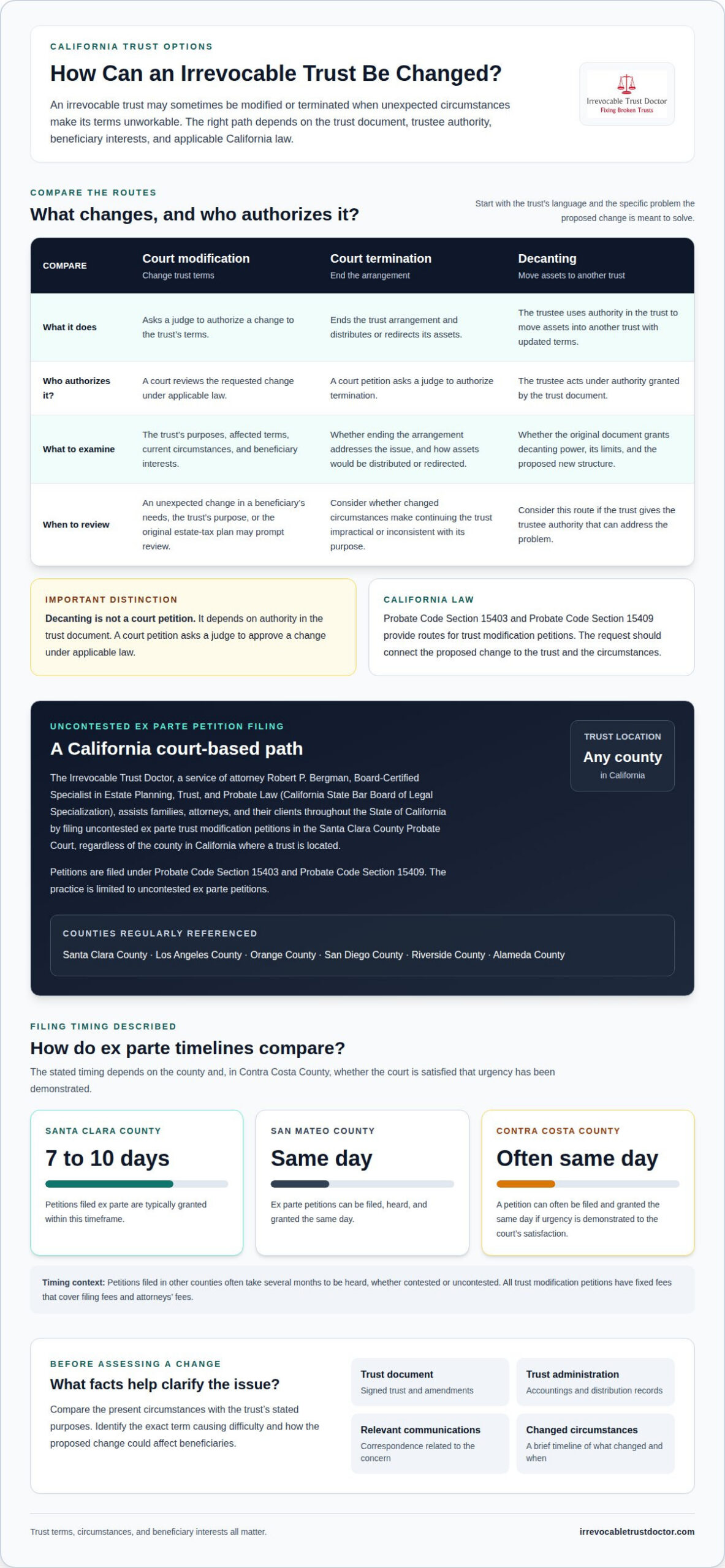
Modification changes trust terms; termination ends the arrangement and distributes or redirects its assets. An unforeseen change in a beneficiary’s needs, the trust’s purpose, or the grantor’s original estate-tax plan may prompt a review. Compare the current situation with the trust’s stated purposes, including provisions for retirement, transfers, or a tax exemption. This comparison can identify the specific term causing difficulty.
Court-Approved Changes
A court-approved change asks a judge to authorize a modification or termination under applicable law. In California, Probate Code Section 15403 and Probate Code Section 15409 provide routes for trust modification petitions. The petition must connect the requested change to the trust and circumstances, rather than simply asserting that the grantor’s lifetime plans have changed. For a Trust Petition Consultation, discuss the trust modification question.
Decanting and Court Modification
Decanting generally means a trustee uses authority in the trust to move assets into another trust with updated terms. It differs from a court petition, which asks a judge to approve a change. Review the original document for a decanting power, its limits, and the proposed structure. If that authority does not address the problem, court modification may be another option.
State Laws and Beneficiary Rights
State law affects which modification paths are available and how beneficiary interests are considered. In California, review the trust alongside the relevant Probate Code provisions before deciding what relief to request. If a trustee’s records or distributions raise concerns, preserve specific examples and identify affected beneficiaries. Their interests, the trust’s purposes, and the requested change all matter when assessing a petition.
Control and modifying an irrevocable trust
Control depends on the trust’s terms and the authority given to its trustee. Reviewing those details can show whether a concern involves a limitation in the document or a possible path to change.
How Should You Compare Attorney Advice?
Compare each attorney’s reasoning, not just the proposed outcome. Ask both to identify the exact trust provisions involved, explain the available path, and describe how a change could affect beneficiaries. For example, one recommendation may preserve a distribution while another changes it. Ask how either approach could affect income, creditors, liability, and the taxable estate. For a second opinion on an irrevocable trust issue, compare the assumptions behind each recommendation and ask what facts could change the analysis.
How Can You Find an Independent Attorney?
An independent attorney review means getting an analysis from an attorney who was not involved in drafting or administering the trust. Clarify the attorney’s role and any prior involvement with the grantor, trustee, or beneficiaries. A second opinion on an irrevocable trust issue can provide a fresh assessment of the document’s terms and the specific concern. Bring the signed trust and amendments, trustee accountings, distribution records, and relevant correspondence. Include documents about the current situation, such as a proposed transfer or income statement, if they relate to the question. A brief timeline can help explain what changed and when.
If you need help framing a specific question about a possible trust change, a Trust Petition Consultation can focus the discussion on the trust’s terms and circumstances.
The Irrevocable Trust Doctor: Irrevocable Trust Modification Petition
The Irrevocable Trust Doctor, a service of attorney Robert P. Bergman, Board-Certified Specialist in Estate Planning, Trust, and Probate Law (California State Bar Board of Legal Specialization), assists families, attorneys, and their clients throughout the State of California with uncontested trust modification petitions. If a court petition may address the issue, an Irrevocable Trust Modification Petition can seek a change under Probate Code Section 15403 or Probate Code Section 15409.
These petitions are filed ex parte in Santa Clara County Probate Court, meaning they proceed without a formal hearing, regardless of the California county where the trust is located. This process is for uncontested matters only. A Trust Petition Consultation can help clarify whether the issue fits this process and what petition may address it.
To discuss an uncontested trust modification, contact The Irrevocable Trust Doctor.
Choose a clear next step for the trust
Before pursuing a change, write down what you want the trust to achieve now. Be specific: identify what should work differently, whose interests the change would affect, and which original purpose should remain intact. This gives a legal review a focused question to address, rather than a broad concern that the trust feels outdated.
A second opinion on an irrevocable trust issue can clarify the available options and the reasoning behind them. Whether a particular change is possible depends on the trust’s terms, the circumstances, and applicable California law. Use the analysis to identify the questions that need answers before moving forward.
If you’re ready to discuss your situation, schedule a Trust Petition Consultation. A clear, informed next step can help you move ahead with greater confidence.
Frequently Asked Questions
Can you change or undo a trust after it is created?
Sometimes, but an irrevocable trust generally can’t be undone simply because the grantor’s wishes have changed. In California, a court petition may seek modification or termination under Probate Code Section 15403 or Probate Code Section 15409. Start by identifying the specific result you want, such as changing a distribution term or ending the trust, then compare that request with the document’s language.
Other Options: Can the Courts Help?
Yes. A California court can consider a petition to modify or terminate an irrevocable trust. The request should identify the provision at issue, explain the circumstances supporting the proposed change, and describe how it relates to the trust’s purpose and beneficiaries. For example, if an outdated distribution term no longer addresses a beneficiary’s needs, explain what has changed and what relief you are requesting.
Second Option: Can I Blow it Up?
“Blowing up” a trust is not a legal procedure; the relevant question is whether termination is available. A court petition may ask to end the trust, but that differs from simply closing an account or distributing its assets. Before taking action, identify the trust property, beneficiaries, and proposed distribution plan so the requested outcome is clear.
What does it cost and how long does it take?
Fees for trust modification petitions are fixed, and the applicable fee depends on the petition’s circumstances; the amount is provided after a quote request. In Santa Clara County, uncontested ex parte petitions are typically granted in 7 to 10 days. The time involved depends on the court process and whether the matter qualifies as an uncontested ex parte petition.
What issues commonly arise with irrevocable trusts?
Common concerns include a trustee’s handling of distributions, unclear or outdated terms, and a trust structure that no longer fits its intended purpose. For example, beneficiaries may disagree about whether a distribution follows the document, or a successor trustee may face unclear instructions. Keep the trust, amendments, accountings, and relevant communications together to make the issue easier to assess.

Article by
Robert P. Bergman, Attorney at Law
Attorney Robert P. Bergman ("Bob Bergman") has been a Board-Certified Specialist in Estate Planning, Trust and Probate Law since 2011, as certified by the California State Bar Board of Legal Specialization. For several years, Bob has assisted families and the clients of other attorneys with obtaining court orders through trust modification petitions to make necessary modifications to existing irrevocable trusts. Bob is friendly, very approachable, and believes in explaining complex legal topics in clear ordinary language so that his clients understand exactly what they're doing and why they're doing it.
Bob is often able to assist clients throughout California who are in other counties than his home county of Santa Clara through his approach to trust modification petitions.