
Disclaimer
This article is for informational purposes only. Nothing in this article is intended to replace legal advice from a competent attorney or be considered legal guidance for anybody's specific legal situation. Nobody should rely on information in this article in making legal decisions without such consultation.
A petition to terminate a trust when its purpose fails in California may be appropriate if the trust’s purpose has become impossible to achieve or has been fulfilled. Probate Code Section 15407 identifies five termination events, including the end of the trust’s term, an unlawful purpose, and revocation when permitted. Even after termination, the trustee may retain authority to complete necessary winding-up tasks.
It’s understandable to expect a trust to end when it can no longer serve the reason it was created. But the trust’s terms, the changed circumstances, and beneficiary consent all affect whether termination is available or modification is a better fit.
This article explains when California law recognizes termination, how beneficiary agreement affects a court petition, and what Probate Code Section 15407 provides. You’ll also see how the trust’s remaining responsibilities may continue after its purpose ends.
Key Takeaways
- According to the California Legislature, Probate Code Section 15409 allows a trustee or beneficiary to petition to modify or terminate a trust when unanticipated circumstances would defeat or substantially impair its purposes.
- Beneficiary consent can affect whether a court may terminate or modify an irrevocable trust, especially when the trust has a material purpose that remains unfulfilled.
- Probate Code Section 15407 identifies events that terminate a trust, including when its purpose is fulfilled or becomes impossible or unlawful.
- Termination does not necessarily end the trustee’s work immediately; understand what winding-up responsibilities may remain.
When Does a Trust Terminate in California?
A trust may end when its stated purpose has been fulfilled, becomes impossible or unlawful, or its term expires. A settlor’s death alone doesn’t necessarily end a trust; administration and distributions may continue. According to the California Legislature, under California Probate Code Section 15409, a trustee or beneficiary may petition to modify or terminate a trust when unanticipated circumstances would defeat or substantially impair its purposes.
A purpose may be impossible to fulfill if changed circumstances make the trust’s intended result unattainable. It may be unlawful if carrying it out would violate the law.
Probate Code Section 17200 provides a court process for trust internal affairs. A petition should identify the trust, describe the changed circumstances, explain the requested modification or termination, and identify affected beneficiaries. The trust document and supporting facts help the court assess the request. After a settlor’s death, an irrevocable trust may still be subject to a petition if its purposes are impaired.
A court may give instructions about trust administration or consider modifying or terminating the trust. In a dispute over a trustee’s conduct, a petition may also seek the trustee’s removal. Temporary orders, including an injunction to stop a specific action, may address urgent concerns while the case proceeds.
Ex parte means a request made without a formal hearing. Uncontested ex parte trust modification petitions can be filed in Santa Clara County Probate Court even when the trust is located elsewhere in California. The correct court and filing path depend on the petition and circumstances; Probate Code Section 17200 addresses court proceedings concerning internal affairs.
Filing fees and overall costs depend on the petition’s scope, required court filings, notice, and whether beneficiaries contest the request. These factors shape the work involved, so there is no single typical total for every trust termination petition.
How Do Beneficiary Consent and Material Trust Purposes Affect Termination?
Beneficiary consent can shape whether a California court may modify or terminate an irrevocable trust. Under Probate Code Section 15403, all beneficiaries may petition for a change, but the court must consider whether it would defeat a material purpose of the trust. A material purpose is an important objective reflected in the trust’s terms, such as preserving assets for later distribution rather than paying them out immediately.
Consent alone doesn’t settle the issue. If the trust’s purpose remains active, a court may decline to terminate it even when beneficiaries agree. Beneficiaries seeking an earlier distribution should identify the trust’s objectives and explain how changed circumstances affect them, rather than relying only on a preference for an earlier inheritance.
Start by reviewing the trust document and identifying current beneficiaries, remainder beneficiaries who receive assets later, and contingent beneficiaries whose interests depend on a future event. Probate Code Section 86 includes people with present or future interests, whether vested or contingent, within the definition of a beneficiary. That broader group can affect whose consent matters.
For a revocable trust, the settlor’s authority to change or revoke it differs from the rules for an irrevocable trust. Probate Code Section 15404 allows a settlor and all beneficiaries to modify or terminate a trust by written consent without court approval. If a beneficiary is a minor or lacks capacity, Probate Code Section 15405 provides a court proceeding for consent on that person’s behalf. Notice and proper representation help protect those interests; an attorney can assess the beneficiary list before filing.
If the trust’s beneficiaries agree but material-purpose or representation questions remain, a trust petition consultation can help clarify the consent issues before preparing a petition.
When Does California Probate Code § 15407 Terminate a Trust?
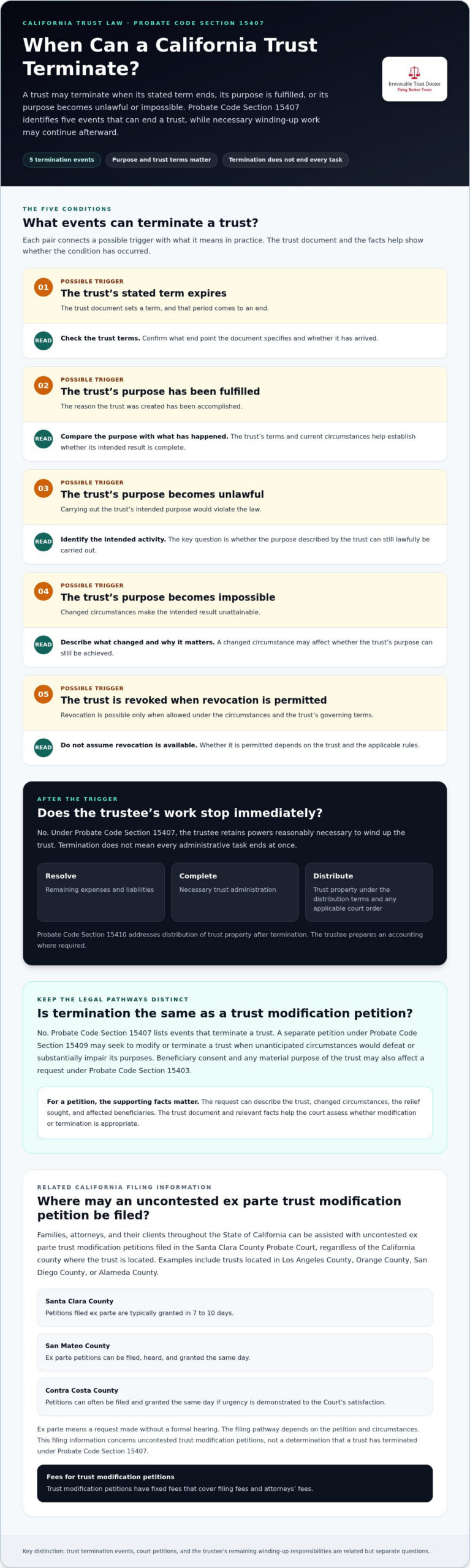
Probate Code Section 15407 identifies five events that terminate a trust. The rule focuses on the trust’s term, purpose, and permission to revoke. A trust document can help show whether an event occurred and whether changed circumstances now defeat the intended purpose. Termination under this section is distinct from asking a court to modify an irrevocable trust.
- The trust’s stated term expires.
- The trust’s purpose has been fulfilled.
- Its purpose becomes unlawful.
- Its purpose becomes impossible to fulfill.
- The trust is revoked when revocation is permitted.
For example, if a trust directs an asset to support an activity that can no longer lawfully take place, its purpose may be unlawful or impossible to fulfill. The key question is what the document intended and how circumstances affect that purpose. A petition may ask the probate court to determine whether termination is appropriate or modification would better preserve the settlor’s intent.
How are trust assets distributed after a California court terminates a trust? The trustee follows the trust’s distribution terms and any applicable court order. Before final distribution, the trustee resolves remaining expenses and liabilities, completes necessary administration, and prepares an accounting where required. Probate Code Section 15410 addresses distribution of trust property after termination. Under Probate Code Section 15407, the trustee retains powers reasonably necessary to wind up the trust, so termination does not mean every task ends immediately.
To assess how Section 15407 applies to a trust document and its remaining assets, schedule a trust petition consultation.
How Can The Irrevocable Trust Doctor Help With an Irrevocable Trust Modification Petition?
The Irrevocable Trust Doctor assists families, attorneys, and clients throughout the State of California with uncontested ex parte trust modification petitions under Probate Code Section 15403 and Probate Code Section 15409. Petitions may be filed in Santa Clara County Probate Court regardless of where the trust is located. The practice also regularly files uncontested ex parte petitions in San Mateo and Contra Costa Counties.
Santa Clara County petitions are typically granted in 7 to 10 days. San Mateo County petitions can be filed, heard, and granted the same day. Contra Costa County petitions can often be filed and granted the same day if the court finds urgency. Petitions filed in other counties often take several months. “Clean” means: “No interested parties object to the action. All interested parties agree to waive notice of a hearing. All interested parties consent to the petition.”
A Trust Petition Consultation can help clarify whether an uncontested modification petition fits the circumstances. To discuss your situation, contact The Irrevocable Trust Doctor.
Prepare for a Clear Next Step
Before deciding whether to pursue a petition to terminate a trust when its purpose fails in California, write down the outcome the trust was designed to achieve and what has changed. Gather the trust document, a concise timeline of relevant events, and any written positions beneficiaries have shared. This gives the discussion a practical focus: the desired result, why the current terms no longer work, and whether the affected people agree.
A focused review can help distinguish a request to end the trust from a request to adjust its terms. It can also identify questions that should be resolved before preparing a court filing. If you’re ready to discuss the circumstances and possible petition, schedule a trust petition consultation. A careful next step can bring greater clarity to a difficult trust situation.
Frequently Asked Questions
Can Beneficiaries Force a Trust to End?
Beneficiaries cannot require termination simply because they want their inheritance sooner. All beneficiaries of an irrevocable trust may petition under Probate Code Section 15403, but the court considers whether ending it would defeat a material purpose. For example, a trust designed to preserve assets until a beneficiary reaches a specified age may have a purpose that remains active.
Can a trust be modified after the person who made it dies?
Yes, a court may modify an irrevocable trust after the settlor dies if the legal basis for a change is established. For instance, if an unexpected event makes a trust’s original distribution plan impractical, a trustee or beneficiary may petition under Probate Code Section 15409. The key is to connect the changed circumstances to the trust’s purpose, not simply request different terms.
Do Beneficiaries Have Other Options When Circumstances Change?
Yes. Beneficiaries may seek to modify the trust instead of asking to terminate it. If an unexpected circumstance interferes with the trust’s objectives, a petition can explain how revised terms would address the problem while preserving the settlor’s intent. For example, beneficiaries might support changing how a distribution is managed rather than ending the arrangement entirely.
Does the trust document itself matter for modification rights?
Yes. The document describes the settlor’s intended purposes, distribution terms, and any conditions beneficiaries must meet. These provisions help the court assess whether a requested change fits the trust’s design. Read the full document, including amendments, before considering options. A revocable trust differs from an irrevocable trust, so first identify its status and the stated amendment provisions.
What California Probate Code section allows termination of a trust when its purpose fails?
Probate Code Section 15407 identifies five events that terminate a trust, including when its purpose is fulfilled or becomes impossible or unlawful. Probate Code Section 15409 separately allows a trustee or beneficiary to petition when unanticipated circumstances would defeat or substantially impair the trust’s purposes. The distinction matters: one provision identifies termination events, while the other provides a petition route for changed circumstances.

Article by
Robert P. Bergman, Attorney at Law
Attorney Robert P. Bergman ("Bob Bergman") has been a Board-Certified Specialist in Estate Planning, Trust and Probate Law since 2011, as certified by the California State Bar Board of Legal Specialization. For several years, Bob has assisted families and the clients of other attorneys with obtaining court orders through trust modification petitions to make necessary modifications to existing irrevocable trusts. Bob is friendly, very approachable, and believes in explaining complex legal topics in clear ordinary language so that his clients understand exactly what they're doing and why they're doing it.
Bob is often able to assist clients throughout California who are in other counties than his home county of Santa Clara through his approach to trust modification petitions.