
Disclaimer
This article is for informational purposes only. Nothing in this article is intended to replace legal advice from a competent attorney or be considered legal guidance for anybody's specific legal situation. Nobody should rely on information in this article in making legal decisions without such consultation.
An irrevocable trust can still have its trustee changed, but the process depends on the trust’s terms and the reason for the change. If you need to change the trustee of an irrevocable trust in Los Angeles, California Probate Code Section 15660 directs attention to the procedure in the trust document, while Probate Code Section 15642 addresses trustee removal under state law. A court may become involved when the circumstances call for it.
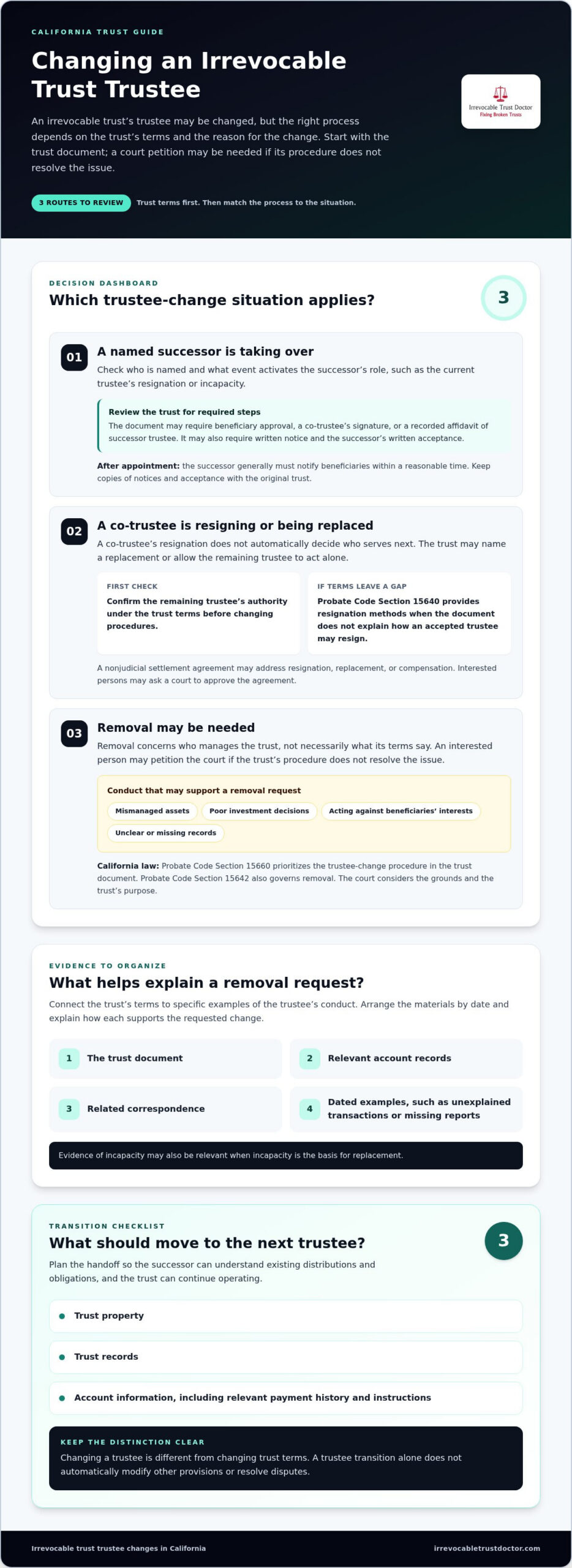
It’s understandable to assume “irrevocable” means nothing can ever change. But replacing a trustee is different from changing a trust’s terms, and the right process depends on whether you’re appointing a named successor, replacing a co-trustee, or seeking court action. For someone searching how to change a trustee of an irrevocable trust in Los Angeles, the key first step is to determine which situation applies. This article explains what to review before moving forward.
Key Takeaways
- Identify whether concerns about a trustee’s conduct may support removal, and gather records that clearly show the issue.
- Read the trust’s successor-trustee provisions closely; they may require written acceptance, notice, or additional steps before the transition takes effect.
- Before a co-trustee resigns or is replaced, determine whether the trust names a replacement or allows the remaining trustee to act alone.
- Plan for a complete handoff of trust property, records, and account information so the next trustee can manage the trust effectively.
When Can an Irrevocable Trust Be Changed?
An irrevocable trust’s terms and its trustee are separate issues. In California, the trust document and the circumstances determine whether a trustee can be replaced under the document or whether a court petition is needed.
Why Might a Trust Need Changes?
A trust change updates terms that no longer serve the trust’s purpose. For example, changed circumstances may make a distribution rule impractical, while unclear language or a drafting error may conflict with the grantor’s intent. That differs from a revocable trust, which its creator may generally change while retaining the power to do so. Before seeking an update, identify the specific provision and explain why it no longer works.
What Are Grounds for Trustee Removal?
Trustee removal addresses who manages the trust, not necessarily what its terms say. Mismanaging assets, poor investment decisions, acting against beneficiaries’ interests, or failing to keep clear records may support a removal request. California Probate Code Section 15660 gives priority to the trustee-change procedure in the document; Probate Code Section 15642 also governs removal. Trust modification petitions have fixed fees covering filing fees and attorney fees. This does not state the cost of separate trust litigation.
How Can You Change a Trustee in California?
To change a trustee, first follow any replacement procedure in the trust document. If that procedure does not resolve the issue, an interested person may petition the court. The court considers the grounds for removal and the trust’s purpose. The time required depends on the court process and whether the request is contested. Changing trust terms, unlike changing the trustee alone, may also have estate, gift, generation-skipping transfer, or income tax consequences.
What Documents and Evidence Support a Removal Request?
For a trustee removal request involving a Los Angeles trust, connect the trust’s terms to specific evidence of the trustee’s conduct. Gather the trust document, relevant account records, correspondence, and examples such as unexplained asset transactions or missing reports. Organize the materials by date and explain how each supports the requested change. Evidence of incapacity may be relevant when that is the basis for replacement. Clear records help explain why removal is sought and how the proposed action serves the trust’s purpose.
How Do You Update a Successor Trustee?
Yes. A California trust document may set out how to appoint or replace a successor trustee. California Probate Code Section 15660 gives priority to the trustee-change procedure in the trust document, so read its provisions before preparing notices or changing account access.
Start by identifying the named successor and the event that activates their role, such as the current trustee’s resignation or incapacity. Then check for additional requirements. The document may call for beneficiary approval, a co-trustee’s signature, or a recorded affidavit of successor trustee. These conditions can affect when the appointment takes effect.
If the document makes the change effective after the outgoing trustee receives notice that the successor has accepted, provide written notice and keep proof of delivery. The successor should also provide written acceptance. After taking office, the successor generally must notify beneficiaries within a reasonable time. Follow the trust’s notice requirements and keep copies with the original trust.
Plan the handoff as a separate step. The outgoing trustee typically turns over trust property, records, and account information, allowing the successor to understand existing distributions and obligations. For example, if a beneficiary expects regular distributions, transfer the relevant payment history and instructions along with account records. A revocable trust and an irrevocable trust may have different amendment rules, so don’t assume changing a successor automatically modifies other terms or resolves disputes.
If you’re weighing whether the trust’s succession provisions need court modification, a Trust Petition Consultation can help assess the issue and possible petition.
Yes. The trust document may specify the approvals, signatures, notices, and other conditions required to appoint or replace a successor trustee.
How Can a Co-Trustee Resign or Be Replaced?
A co-trustee’s resignation doesn’t automatically decide who serves next. Review the original trust document first: it may name a successor to serve alongside the remaining trustee or permit that trustee to act alone. If the document doesn’t explain how an accepted trustee may resign, California Probate Code Section 15640 provides resignation methods. The trust’s specific terms shape the transition.
If the document leaves a gap, a nonjudicial settlement agreement may help. It is a written agreement among relevant trust parties that addresses an issue without first seeking court approval. It may cover a trustee’s resignation, appointment of a replacement, or compensation. Interested persons may ask a court to approve the agreement, so identify unresolved disputes before relying on it.
Consider how the change affects trust operations. A California transition may require updated trust certifications for financial institutions or new deeds and recorded trust certifications for real property. The departing trustee may owe a final accounting for the period served, unless the trust or beneficiaries waive it. Identify each affected institution or property record, then plan the paperwork needed to maintain continuity.
For example, if one co-trustee handled distributions and another managed investments, clarify who will assume each responsibility. Confirm the remaining trustee’s authority under the trust terms before changing transaction procedures. A clear division of duties can help protect beneficiaries’ interests during the transition.
If the trust’s provisions don’t resolve the change, schedule a Trust Petition Consultation to discuss whether a court petition may address the issue.
The Irrevocable Trust Doctor: Irrevocable Trust Modification Petition
The Irrevocable Trust Doctor, a service of attorney Robert P. Bergman, Board-Certified Specialist in Estate Planning, Trust, and Probate Law (California State Bar Board of Legal Specialization), assists families, attorneys, and their clients with uncontested trust modification petitions. If a trustee change requires modifying trust terms, an Irrevocable Trust Modification Petition may provide a court-based path under Probate Code Section 15403 or Probate Code Section 15409.
Petitions can be filed as uncontested ex parte matters in the Santa Clara County Probate Court, regardless of where the trust is located in California. The process for an ex parte matter can depend on the circumstances. Santa Clara County petitions are typically granted in 7 to 10 days. The office handles uncontested ex parte petitions only, not contested petitions. A Trust Petition Consultation can help assess whether a petition fits the trust’s circumstances and proposed change.
If you’d like to discuss your situation, contact The Irrevocable Trust Doctor.
Prepare for a Clear Next Step
Before deciding how to change a trustee of an irrevocable trust in Los Angeles, define the outcome you need. Are you appointing a named successor, addressing a co-trustee’s departure, or seeking a court-approved change? Keeping these goals distinct helps focus the next steps.
Gather the trust document and organize the facts around the requested outcome. Note the relevant trustee provisions, the change you are considering, and any practical issue affecting trust management. This provides a focused starting point for assessing whether the document’s procedure applies or a petition may be needed.
A Trust Petition Consultation can help you examine that path and identify a practical next step. Arrange a Trust Petition Consultation to discuss your circumstances and move forward with greater clarity.
Frequently Asked Questions
Who Can Remove a Trustee?
A court can remove a trustee, and a trust document may authorize a trust protector to replace one. Beneficiaries may seek court action when they have grounds, such as conduct that harms their interests. Start by checking who the trust authorizes to make a change. That helps clarify whether the next step is under the document or through a court petition.
When can beneficiaries remove a trustee under California Probate Code?
Beneficiaries can ask a California court to remove a trustee when the trust’s circumstances and applicable law support removal. Probate Code Section 15642 governs trustee removal, while the trust document may set out its own change procedure. For example, beneficiaries concerned about trust management should connect their request to specific conduct and explain how the requested replacement would address the issue.
Can a California court remove or replace an irrevocable trust trustee, and on what grounds?
Yes. A California court may remove or replace an irrevocable trust trustee when the facts support intervention. Mismanagement and actions contrary to beneficiaries’ best interests are relevant concerns. The court may also consider whether the proposed change fits the trust’s purpose and how it affects beneficiaries. Distinguish a request to change the person managing the trust from a request to change its terms.
Can beneficiaries consent to a trustee change without court approval in California?
Sometimes. A nonjudicial settlement agreement can address a trustee’s resignation or appointment without first obtaining court approval. Such an agreement generally involves the trustee and current and remainder beneficiaries. Consent alone does not make every proposed change effective. The agreement must address the matter appropriately, and interested persons may ask a court to approve it.
What is the process to petition Los Angeles Superior Court to change a trust trustee?
Begin by reviewing the trust and identifying the specific change requested. Prepare a petition that explains the basis for court action, identifies a proposed replacement if applicable, and includes relevant trust terms and records. The court considers the stated grounds and the effect on beneficiaries. Keep the requested relief focused, especially when the concern involves trustee conduct rather than other trust provisions.

Article by
Robert P. Bergman, Attorney at Law
Attorney Robert P. Bergman ("Bob Bergman") has been a Board-Certified Specialist in Estate Planning, Trust and Probate Law since 2011, as certified by the California State Bar Board of Legal Specialization. For several years, Bob has assisted families and the clients of other attorneys with obtaining court orders through trust modification petitions to make necessary modifications to existing irrevocable trusts. Bob is friendly, very approachable, and believes in explaining complex legal topics in clear ordinary language so that his clients understand exactly what they're doing and why they're doing it.
Bob is often able to assist clients throughout California who are in other counties than his home county of Santa Clara through his approach to trust modification petitions.