
Disclaimer
This article is for informational purposes only. Nothing in this article is intended to replace legal advice from a competent attorney or be considered legal guidance for anybody's specific legal situation. Nobody should rely on information in this article in making legal decisions without such consultation.
A credible estimate starts with the facts of your petition, not a percentage. California courts don’t publish an official irrevocable trust modification success rate California applicants can use to predict an individual case. The legal basis, beneficiary consent, and whether the petition is uncontested matter more.
If you’re worried about an uncertain outcome or a long court process, that concern is understandable. This article explains what a meaningful case assessment considers and how petitions under Probate Code Section 15403 or Section 15409 may apply. Attorney Robert P. Bergman assists families, attorneys, and their clients throughout the State of California with uncontested ex parte petitions filed in Santa Clara County, regardless of where the trust is located. Ex parte means the petition proceeds without a formal hearing; Santa Clara County petitions are typically granted in 7 to 10 days. You’ll learn what to consider before taking a focused next step.
Key Takeaways
- The irrevocable trust modification success rate California petitioners can rely on is not captured by one verified percentage; assess the legal basis and facts of your specific petition instead.
- Clarify the change you’re seeking, review the trust document, and organize the facts that support the legal grounds before assessing the petition’s prospects.
- Probate Code Section 15403 and Probate Code Section 15409 provide different potential paths for seeking a trust modification, so identifying which may fit your circumstances is an important first step.
- Families, attorneys, and clients across California, including Los Angeles, Alameda, and Sacramento Counties, may be assisted with eligible uncontested ex parte petitions filed in Santa Clara County, regardless of where the trust is located.
Is There a Trust Modification Success Rate in California You Can Rely On?
No verified universal percentage predicts whether a particular California trust modification petition will be approved. The outcome depends on the legal basis asserted and the facts supporting the proposed change, so no percentage can guarantee a result.
A general success rate is an aggregate figure, while a case-specific legal assessment examines whether the law and evidence support the requested change in one trust’s circumstances. That distinction matters: the phrase irrevocable trust modification success rate California doesn’t provide a reliable forecast for an individual petition.
For background, Trust law principles help explain the framework in which trusts operate. But general information about trust law cannot determine whether a particular court will approve a proposed modification.
Why can’t one percentage predict every California trust petition?
Petitions may involve different trust terms, proposed changes, family circumstances, and legal grounds. A percentage that combines unlike cases could obscure the very facts that matter in yours. For a useful assessment, identify what you want changed, locate the relevant provisions in the trust document, and gather records that explain why the change is being requested.
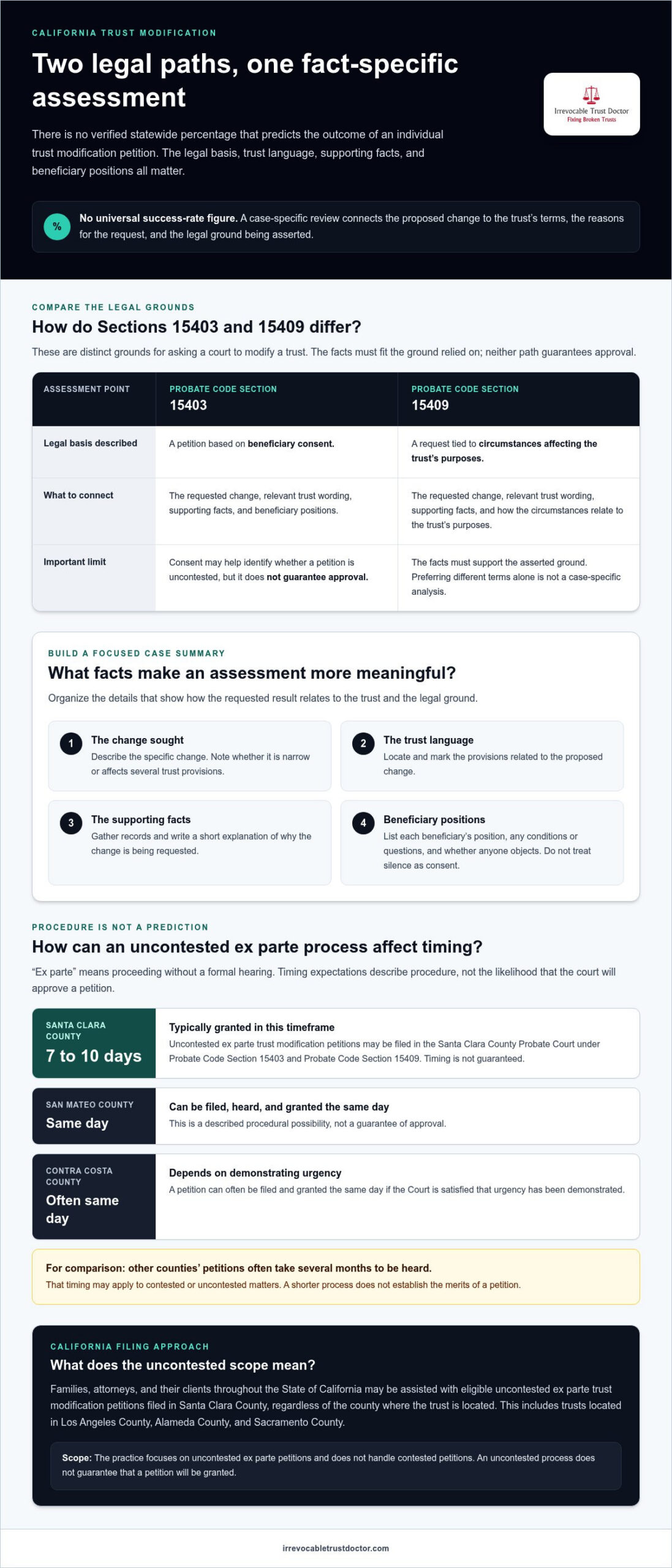
The legal basis also matters. Probate Code Section 15403 and Probate Code Section 15409 provide distinct grounds for asking a court to modify a trust, so the facts must be considered in relation to the basis asserted. A petition that is uncontested differs from a contested matter, but the absence of a dispute doesn’t guarantee approval. The court still considers the petition and supporting information.
A practical first step is to prepare a concise case summary: the specific change sought, the trust language involved, the reason for the request, and whether anyone objects. That information supports a more meaningful discussion of legal fit than a statewide percentage can.
What Factors Can Affect an Irrevocable Trust Modification Petition’s Prospects?
A meaningful assessment connects four things: the change being requested, the trust’s wording, the facts explaining the need for the change, and the legal basis for asking the court to act. No single irrevocable trust modification success rate California figure can account for how those details fit together in an individual petition.
How do legal grounds and beneficiary positions shape the assessment?
Start with the requested change. Is it narrow and clearly described, or does it affect several trust provisions? Next, identify the exact language in the trust document and gather records that explain why the change is being proposed. The clearer the connection between the trust terms, the supporting facts, and the requested result, the more focused the legal assessment can be.
At a high level, Probate Code Section 15403 concerns a petition based on beneficiary consent, while Probate Code Section 15409 addresses a request tied to circumstances affecting the trust’s purposes. The facts must support the legal ground being asserted; simply preferring different terms is not, by itself, a case-specific analysis. This framework helps assess legal fit, not predict what a judge will decide.
Beneficiary positions also matter to whether a petition fits an uncontested process. If the affected beneficiaries agree, document that agreement and note any conditions or questions. If someone objects, identify the concern rather than treating silence as consent. We assist with uncontested petitions and don’t handle contested petitions, so the presence of opposition is an important early distinction.
For a focused review, organize the trust, mark the provisions you want changed, write a short explanation of the reasons, and list each beneficiary’s position. A trust petition consultation can help connect those details to the proposed petition.
How Can California’s Uncontested Ex Parte Process Affect Expectations?
An uncontested ex parte petition follows a process intended for a matter without an active dispute. “Ex parte” means proceeding without a formal hearing. It can affect expectations about procedure and timing, but it isn’t a success rate or a guarantee that the court will grant a petition.
Attorney Robert P. Bergman assists families, attorneys, and their clients throughout the State of California with uncontested ex parte trust modification petitions filed in the Santa Clara County Probate Court under Probate Code Section 15403 and Probate Code Section 15409. If a trust is located in Los Angeles County, Alameda County, or Sacramento County, an eligible petition may still be filed in Santa Clara County. The trust’s county location alone doesn’t prevent this filing approach.
What timing does the firm describe for uncontested ex parte petitions?
Timing depends on the county and the circumstances. Santa Clara County petitions are typically granted in 7 to 10 days, but that is not guaranteed. San Mateo County ex parte petitions can be filed, heard, and granted the same day. In Contra Costa County, a petition can often be filed and granted the same day if the Court is satisfied that urgency has been demonstrated.
These are procedural timing expectations, not predictions about whether a petition will be approved. Other counties’ petitions often take several months to be heard, whether contested or uncontested. The firm’s practice focuses on uncontested ex parte petitions and does not handle contested matters. So, when considering the irrevocable trust modification success rate California readers may hope to find, keep the distinction clear: a shorter process doesn’t establish the merits of a case or promise its outcome.
Trust-modification petitions have fixed fees covering filing fees and attorney fees. Reviewing the trust petition fees and costs can help you understand the fee structure as you consider next steps. Gather the trust document, the specific change sought, and information about beneficiary agreement to support a focused assessment.
Turn Uncertainty Into a Focused Next Step
A percentage can’t tell you how your trust’s terms, proposed change, and family’s circumstances fit together. A focused review can help replace speculation about the irrevocable trust modification success rate California with a clearer understanding of the legal questions your petition raises.
Robert P. Bergman is a Certified Specialist in Estate Planning, Trust, and Probate Law. His practice assists families, attorneys, and their clients throughout the State of California, focusing on uncontested ex parte trust-modification petitions. If you’re ready to discuss your circumstances, gather the trust document and note the specific change you’re seeking and any beneficiary concerns. These details can help make the conversation more productive.
Schedule a trust petition consultation to discuss a case-specific assessment and possible next steps. A clearer plan can begin with one focused conversation.
Frequently Asked Questions
Is there a published success rate for modifying an irrevocable trust in California?
No verified statewide success-rate percentage is published for California irrevocable trust modification petitions. A figure would be useful only if it applied to cases with comparable legal grounds, facts, and beneficiary positions. Treat the phrase irrevocable trust modification success rate California as a question to investigate, not a prediction. For a practical review, identify the requested change and the facts that support it.
Can an irrevocable trust modification petition be filed in Santa Clara County if the trust is located elsewhere in California?
Yes, an eligible uncontested petition may be filed in Santa Clara County even if the trust is located in another California county. For example, a trust located in Los Angeles County, Orange County, or Sacramento County may be considered for this filing approach. The trust’s location alone doesn’t establish eligibility, so organize the trust document and proposed change for a case-specific assessment.
How long does an uncontested ex parte trust modification petition take in California?
Timing depends on the county and circumstances. Santa Clara County petitions are typically granted in 7 to 10 days, while San Mateo County matters can be filed, heard, and granted the same day. In Contra Costa County, same-day filing and grant may be possible if the Court is satisfied that urgency is demonstrated. These are expectations, not guarantees; other counties often take several months.

Article by
Robert P. Bergman, Attorney at Law
Attorney Robert P. Bergman ("Bob Bergman") has been a Board-Certified Specialist in Estate Planning, Trust and Probate Law since 2011, as certified by the California State Bar Board of Legal Specialization. For several years, Bob has assisted families and the clients of other attorneys with obtaining court orders through trust modification petitions to make necessary modifications to existing irrevocable trusts. Bob is friendly, very approachable, and believes in explaining complex legal topics in clear ordinary language so that his clients understand exactly what they're doing and why they're doing it.
Bob is often able to assist clients throughout California who are in other counties than his home county of Santa Clara through his approach to trust modification petitions.